DGCA Ground Classes vs Online Pilot Courses — Which Is Better for CPL in 2026?
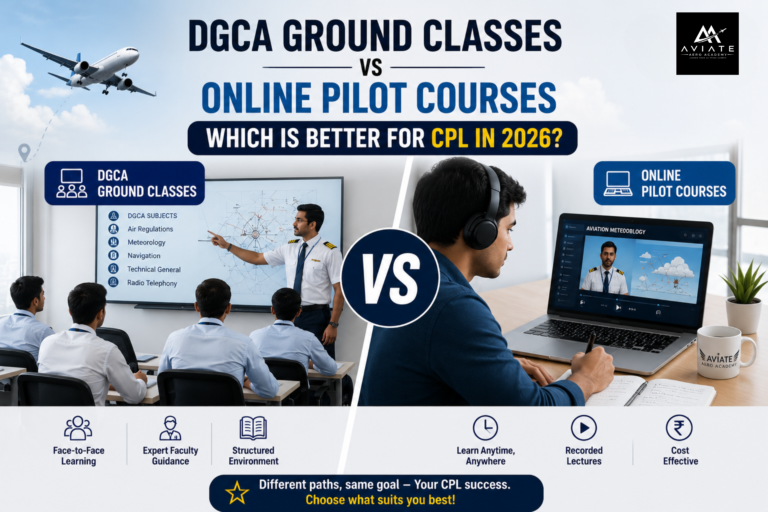
Every aspiring commercial pilot in India faces the same early decision: prepare for DGCA written exams through in-person ground classes or sign up for an online pilot course? It sounds simple. It is not — because the wrong choice for your situation can add months to your CPL timeline and thousands of rupees in re-examination costs.
This guide gives you an honest, format-neutral comparison. Not a sales pitch for either option — a clear breakdown of what each format does well, where each falls short, and which subjects genuinely need in-person instruction versus which work fine online. By the end, you will know exactly which preparation path suits your situation in 2026.
The Quick Comparison — Offline vs Online
| Factor | Ground Classes | Online Courses |
|---|---|---|
| Structure | Fixed schedule with clear progression | Self-paced learning that requires strong discipline |
| Faculty Access | Real-time interaction and immediate doubt clearing | Doubts resolved through chat or scheduled sessions |
| Navigation Calculations | Whiteboard practice with live error correction | More difficult to identify and correct mistakes remotely |
| Flexibility | Fixed timetable and may require relocation | Study anytime from anywhere |
| Course Fees | ₹60,000 – ₹1,50,000 | ₹15,000 – ₹60,000 |
| Peer Learning | Classmates, study groups, and classroom motivation | Mostly individual learning with limited interaction |
| First-Attempt Pass Rate | Generally higher due to structured preparation | Can be lower without consistent self-discipline |
Which DGCA Subjects Need In-Person Teaching?
This is the most important question — and the one most comparison articles skip entirely. Not all five DGCA papers are equally served by online formats.
- Air Regulations — Online works well. Primarily text-based reading and MCQ practice. Strong online resources exist.
- Aviation Meteorology — Online is adequate. Conceptual subject with good video explanations available.
- Air Navigation — In-person strongly recommended. Calculation-heavy. Errors in setup are invisible online and compound fast. Faculty correction in real time is critical.
- Technical General — In-person preferred. Aircraft systems require diagram-level teaching that online resources handle poorly for Indian CPL standard.
- Radio Telephony RTR(A) — Online is adequate. Phraseology-based subject that can be self-studied with recordings.
Key takeaway: Air Navigation and Technical General are the two subjects with the highest self-study failure rates in India. These are exactly where in-person instruction has a measurable, outcome-changing advantage.
The Cost Reality — What Nobody Calculates
Online courses are cheaper on the surface. But the real cost comparison includes what happens if you fail a paper and sit it again.
A failed DGCA paper means re-examination fees, a waiting period before re-booking, and a delay to your overall CPL timeline. If you are studying away from home, add another month or two of accommodation costs. Most importantly — every month your CPL is delayed is a month of First Officer salary you have not started earning. At entry-level ₹1.5 lakh per month, a three-month delay costs ₹4.5 lakhs in deferred income.
First-attempt success is always the economically optimal outcome — regardless of which preparation format you choose. Price the preparation against this, not just against the course fee itself.
Who Should Choose Ground Classes?
- You need external structure and accountability to maintain consistent study habits
- You are targeting first-attempt success across all five papers as a non-negotiable priority
- Air Navigation or Technical General is a weak area for you
- You are preparing for airline cadet programme selection — which tests deep technical knowledge
Who Should Choose Online Courses?
- You are completing flying hours at an international school and cannot attend in-person classes in India
- You are in a Tier 2 or Tier 3 city without access to a quality ground school
- You have strong self-discipline and a daily study routine already established
- You performed well in Physics and Mathematics — solid foundations reduce reliance on remedial teaching
The Smarter Approach — Go Hybrid
The most strategically prepared DGCA students in 2026 are not choosing one format entirely. They use online preparation for Regulations and Meteorology — where it works well — and attend in-person ground classes for Navigation and Technical General, where it matters most.
This split approach keeps overall costs lower than full offline preparation while protecting your first-attempt pass rate in the two subjects that most frequently send students back for a second sitting.