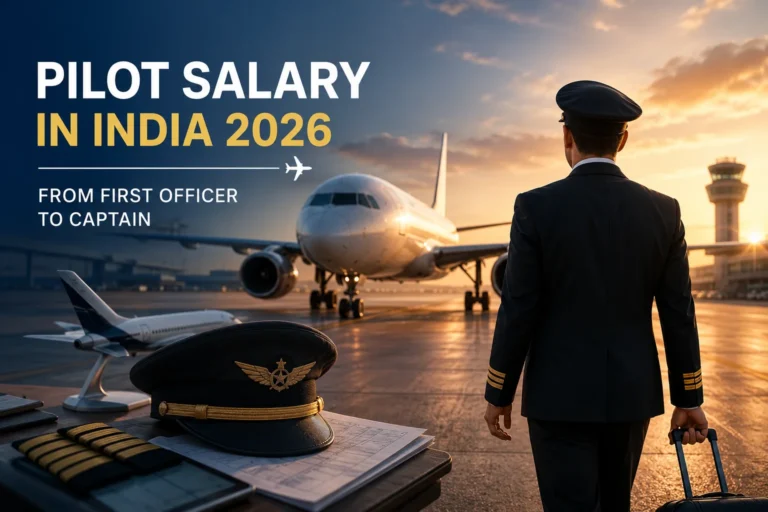
Pilot Salary in India 2026 — From First Officer to Captain
One of the most important questions any aspiring pilot and their family asks before committing to a training investment of INR 40 to 90 lakhs is this: what does a pilot actually earn in India, and is the financial return worth it? The answer in 2026 is unambiguous. India’s aviation industry is experiencing a structural pilot shortage driven by aggressive fleet expansion across IndiGo, Air India, Akasa Air, and SpiceJet. Salaries at every rank have risen significantly over the past three years, and the demand trajectory shows no signs of reversal for the foreseeable future.
This guide provides verified salary data for every rank from fresh CPL holder to airline captain, along with a realistic assessment of the career timeline, the allowances and benefits, and the return on the training investment. If you are considering whether a pilot career makes financial sense for your family in 2026, this is the data you need.
The Aviation Market Driving Salary Growth
India currently operates approximately 700 commercial aircraft and needs more than 8,000 additional pilots over the next five years to support planned fleet growth. IndiGo alone has orders for over 500 new aircraft. Air India is rebuilding its long-haul network under new management. Akasa Air entered the market aggressively and is expanding its domestic routes. This combination of existing demand and pipeline growth has created a competitive hiring environment that directly benefits pilots at every experience level.
For students beginning their training journey today through programmes like those offered at Aviate Aero Academy in Hyderabad, the career timing is genuinely strong. Pilots entering the industry in 2026 and 2027 are entering at the beginning of a significant growth phase — a position that historically produces faster rank progression and better lifetime earnings.
First Officer Salary — Fresh CPL Holder, 2026
After completing your Commercial Pilot License and Type Rating on a specific aircraft — Airbus A320 or Boeing 737 in most cases — you join an Indian airline as a First Officer. Monthly earnings in 2026 range as follows:
- IndiGo: INR 1.8 to 2.5 lakhs per month — basic salary plus flying hour allowance
- Air India: INR 2.0 to 3.0 lakhs per month
- Akasa Air: INR 1.8 to 2.8 lakhs per month
- SpiceJet: INR 1.5 to 2.2 lakhs per month
- Regional carriers operating ATR aircraft: INR 1.2 to 1.8 lakhs per month
These base figures do not capture the full compensation picture. Pilots also receive flying hour allowances of INR 500 to 2,000 per hour flown, per diem payments on overnight stops of INR 3,000 to 8,000 per day on international routes, annual performance bonuses, and complimentary or deeply discounted air travel for the pilot and immediate family. The total compensation package is consistently and significantly higher than the basic salary alone suggests.
Senior First Officer — After 3 to 5 Years of Service
First Officers who demonstrate consistent performance and accumulate the required flying hours are upgraded to Senior First Officer, typically after three to five years of active service. Salaries at this stage rise substantially:
- IndiGo Senior First Officer: INR 3.5 to 5.0 lakhs per month
- Air India Senior First Officer: INR 4.0 to 6.0 lakhs per month
- Other major carriers: INR 3.0 to 4.5 lakhs per month
Senior First Officers with instrument ratings and experience on advanced aircraft variants command the upper end of these ranges. Career progression from First Officer to Senior First Officer is primarily hours-based and performance-driven — both factors that motivated, well-trained pilots can influence directly through consistent performance.
Airline Captain — After ATPL and 1,500+ Hours
The Captain rank delivers some of the highest earnings available in any Indian professional career. After accumulating 1,500 total flying hours and obtaining the Airline Transport Pilot License, pilots are eligible for command upgrade:
- IndiGo Captain: INR 6 to 12 lakhs per month
- Air India domestic route Captain: INR 8 to 14 lakhs per month
- Air India long-haul international Captain: INR 14 to 22 lakhs per month
- Akasa Air Captain: INR 7 to 11 lakhs per month
- SpiceJet Captain: INR 6 to 9 lakhs per month
Wide-body international Captains at Air India operating routes to USA, Europe, and Australia represent the highest earners in Indian commercial aviation. When total compensation including international per diem, allowances, and benefits is calculated, senior captains on long-haul routes can earn INR 25 to 30 lakhs per month in effective total income.
The Return on Investment — An Honest Assessment
CPL training costs range from INR 38 to 60 lakhs for India-based training to INR 47 to 75 lakhs for international training in Philippines, Canada, or Australia. This is a significant investment and every family deserves an honest return-on-investment assessment.
A First Officer earning INR 2 lakhs per month net of living expenses recovers a INR 50 lakh training investment within three to four years of active flying. A Senior First Officer earning INR 4 lakhs per month clears the same investment in approximately two years of savings. A Captain earning INR 10 lakhs per month has a monthly surplus that very few other professions in India can match.
Beyond pure numbers, pilots benefit from one of India’s most comprehensive employer-funded benefit packages including medical insurance, free air travel, structured leave entitlements, and pension contributions at legacy carriers. The career spans 30 to 35 active years before the mandatory retirement age, providing a long window of peak earnings.
Connecting Salary Goals to a Real Training Plan
Salary data only becomes meaningful when connected to a personalised, realistic training plan. At Aviate Aero Academy in Hyderabad, career counselling sessions translate salary aspirations into specific training timelines, country recommendations, and cost projections. We help families understand not just what pilots earn, but exactly how to get there — and how long it realistically takes given each student’s individual profile, budget, and eligibility.
Our guidance covers DGCA ground classes, international flying school selection across six countries, CPL roadmap planning, financial planning for the training investment, and post-CPL career strategy including type rating decisions and airline placement preparation. Over 350 pilots have started their journey with our guidance. Use our free career tools to begin planning yours today.