How to Become a Commercial Pilot in India After 12th — Complete 2026 Guide
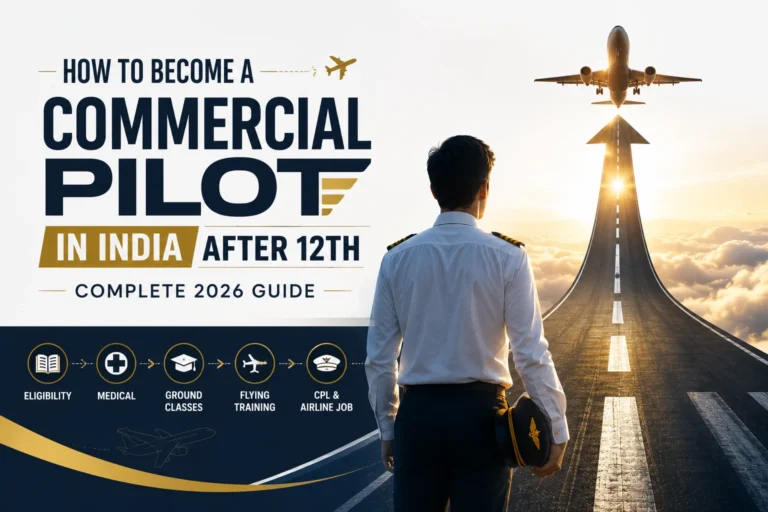
The pilot career is one of the most clearly structured professional pathways available to Indian students after 12th standard. Despite this, the information available to aspiring pilots online is cluttered with conflicting advice, outdated fee figures, and overly optimistic timelines from organisations with a financial interest in your enrolment. This guide was written by Aviate Aero Academy counselling team in Hyderabad — professionals who have guided over 350 students through this exact journey over ten-plus years — and it gives you the complete, accurate picture for 2026, including the parts that most organisations prefer to leave out.
Step 1 — Confirm Eligibility Before Spending Anything
Every aspiring pilot’s first action should be verifying they meet DGCA minimum requirements. These standards are non-negotiable:
- 12th Standard completed with Physics and Mathematics in Science stream
- Minimum 50 percent aggregate marks specifically in Physics and Mathematics — not overall percentage
- Minimum age of 17 years at the time of Student Pilot License application
- Class 2 Medical fitness certificate from a DGCA-authorised Aviation Medical Examiner
- Colour vision — must pass the Ishihara plates test. Colour blindness is a disqualifier for full CPL scope
Use the free eligibility assessment tools on the Aviate Aero Academy Pilot Tools page before spending money on any application or coaching.
Step 2 — Complete Your Aviation Medical Before Anything Else
Aviation medicals — Class 2 for SPL and PPL, Class 1 for CPL — are conducted by DGCA-authorised Aviation Medical Examiners. The most important advice we give at Aviate Aero Academy: do your medical before spending money on ground classes or school applications. A colour vision deficiency or a vision prescription beyond DGCA limits, discovered after paying for months of coaching, is both a financial waste and an emotional setback. Know your medical status first.
Step 3 — Register on the DGCA eCAAT Portal
All Indian pilot licensing happens through the DGCA eCAAT portal at dgca.gov.in. Creating your pilot trainee profile, uploading documents, applying for your Student Pilot License, and registering for DGCA written examinations all occur through this portal. The registration process requires two to four weeks, and documentation formatting errors cause significant and avoidable delays. Aviate Aero Academy provides eCAAT registration guidance as part of every student’s initial counselling support.
Step 4 — Enrol in DGCA Ground Classes
Five written examination papers must be cleared before your CPL can be issued: Air Regulations, Aviation Meteorology, Air Navigation, Technical General, and Radio Telephony for the RTR(A) Licence. What most students discover after starting is that Navigation and Technical General are significantly more demanding than expected. Self-study alone has a poor first-attempt pass rate in these subjects. Structured coaching with concept-clarity sessions, past question analysis, and full mock test series delivers measurably better outcomes.
At Aviate Aero Academy in Hyderabad, our DGCA ground classes are specifically designed around first-attempt success across all five subjects. Typical completion time with structured coaching is approximately six months. DGCA written exam passes remain valid for five years.
Step 5 — Choose Your Country and Flying School
Flying training can be completed at a DGCA-approved school in India or internationally in one of six countries. Each option has different costs, training timelines, weather conditions, visa requirements, and post-training implications. India avoids visa and DGCA license conversion requirements but monsoon disruptions regularly add six to twelve months to training timelines. The Philippines offers the best international cost-value ratio at USD 57,000 to 60,000 with year-round flying weather. Canada delivers a globally recognised Transport Canada CPL at a higher total investment.
Compare all six international training options in detail on the Aviate Aero Academy Global Schools page.
Step 6 — Complete 200 Flying Hours
The DGCA CPL requires 200 total flying hours including 100 hours as Pilot-in-Command, 20 hours of cross-country navigation, 10 hours of instrument flying, and a night flying qualification. This phase takes 18 to 36 months depending on training location and weather patterns. Students training in the Philippines or South Africa typically complete this phase faster than those training in India.
Step 7 — Pass the CPL Skill Test
After completing flying hours and clearing all five DGCA written examinations, a CPL Skill Test with a DGCA-designated examiner formally assesses all practical flying competencies. Upon successful completion, your Commercial Pilot License is officially issued by the DGCA.
Step 8 — Type Rating and First Airline Employment
Airlines require a Type Rating on their specific aircraft before employment. The Airbus A320 Type Rating is the most commercially valuable in India in 2026 — required by IndiGo, Air India Express, and Akasa Air. It takes approximately 45 days and costs INR 20 to 35 lakhs. IndiGo, Air India, and Akasa Air run cadet programmes that fund Type Rating in exchange for a service bond.
Understand the full license progression from CPL to ATPL on the Aviate Aero Academy CPL to ATPL page.
The Guidance That Determines How Fast You Get There
The eight steps above are clear on paper. In practice, students encounter navigational challenges at every transition — between eligibility and school selection, between DGCA registration and exam strategy, between CPL completion and type rating planning. The students who reach their airline seat fastest are not necessarily the wealthiest or the most academically talented. They are the ones who received accurate, honest guidance at each decision point and acted on it efficiently.
At Aviate Aero Academy in Hyderabad, we have been providing that guidance for over a decade. Our counselling covers every stage from eligibility to airline placement. We do not run a flying school — we are the guidance partner that helps you choose the right flying school, prepare for DGCA examinations, plan your finances, handle documentation, and navigate every decision from first enquiry to first airline seat. Our 350-plus trained pilots are the track record.