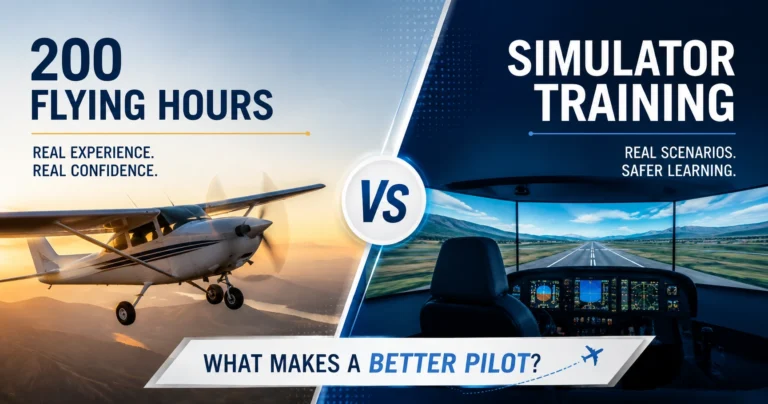
200 Flying Hours vs Simulator Training: What Makes a Better Pilot?
By Shravya, Aviate Aero Academy
For most aspiring pilots in India, one number becomes familiar very early in the journey: 200 flying hours.
It sounds simple. Complete the required hours, clear the exams, get the Commercial Pilot Licence, and move closer to the cockpit. In India, DGCA’s Commercial Pilot Licence requirement includes not less than 200 hours of flight time, with specified components such as Pilot-in-Command time and other flying experience requirements.
But here is the question students and parents must start asking more seriously: does completing 200 flying hours automatically make someone a better pilot?
The honest answer is no.
Flying hours matter. They are essential. They build aircraft handling, confidence, weather judgement, radio communication, situational awareness, and real-world exposure. There is no replacement for sitting in an actual aircraft, feeling the controls, managing uncertainty, responding to live conditions, and learning how theory behaves outside the classroom.
A student who has flown through real crosswinds, changing visibility, busy airspace, aircraft limitations, and instructor feedback develops something a textbook cannot provide: instinct shaped by experience.
But aviation training is changing globally, and simulator training is no longer a secondary tool. It is becoming central to how modern pilots are prepared.
A simulator can do something an aircraft cannot always do safely or repeatedly. It can place a student inside high-pressure scenarios: engine failure, instrument failure, bad weather, rejected take-off, unstable approach, system malfunction, crew coordination breakdown, or decision-making under stress. These situations may be rare in normal flying, but a pilot must still be ready for them.
That is why the debate should not be “flying hours versus simulator training.” That is too simplistic.
The real question is: what combination creates a pilot who is not only licensed, but ready?
Traditional CPL training gives students a strong foundation in aircraft handling. It teaches them to fly. It builds independence. It forces them to understand the relationship between judgement, environment, machine, and responsibility.
This is especially important in the early stages. A pilot must know how an aircraft behaves in the real sky, not only on a screen. A student must experience workload, fatigue, weather changes, imperfect landings, instructor corrections, and the discipline of pre-flight and post-flight routines.
Without this foundation, training becomes theoretical.
But without simulator-based training, the foundation can remain incomplete.
Modern airline flying is not just about stick-and-rudder skills. It is about operating complex aircraft inside a multi-crew environment. It is about communication, standard operating procedures, automation management, threat and error management, and decision-making with another pilot beside you.
That is where simulator training has a powerful role.
ICAO describes the Multi-Crew Pilot Licence as an alternative pathway for ab-initio student pilots to develop the competencies needed to become safe and effective operators of modern commercial air transport aircraft through a seamless, competency-based training programme.
That idea matters because it shifts the conversation from “how many hours did you complete?” to “what competencies have you actually developed?”
A student may complete 200 hours and still struggle with cockpit discipline. Another student may perform well in simulator-based scenarios but lack enough real-world aircraft feel. Both gaps are serious.
This is why students should stop treating pilot training like a checklist.
A better pilot is not made by hours alone. A better pilot is made by the quality of training inside those hours.
Were the flying hours structured properly?
Did the student understand mistakes or merely complete sorties?
Was there strong ground-school preparation before flying?
Did the student learn decision-making or only aircraft handling?
Was simulator training used to sharpen judgement and emergency response?
Did the student build confidence without becoming overconfident?
These are the questions that matter.
For parents, this is even more important. Pilot training is a serious financial decision. Choosing the cheapest or fastest option without understanding training quality can become costly later. A flying school may promise completion. But completion is not the same as readiness.
The aviation industry does not need students who only know how to finish a syllabus. It needs pilots who can think clearly, communicate professionally, follow procedures, respect safety, and remain calm when conditions are not ideal.
That kind of pilot is built through a balanced training ecosystem.
Real aircraft flying builds feel.
Simulator training builds scenario maturity.
Ground school builds technical understanding.
Mentorship builds career clarity.
Discipline connects all of them.
At Aviate Aero Academy, we see this confusion often. Students ask whether they should focus only on flying hours, only on DGCA exams, or only on getting into a flying school quickly. Our answer is always the same: the pilot journey needs a proper roadmap. As a Hyderabad-based aviation training and guidance academy, Aviate Aero Academy supports students with DGCA ground classes, CPL guidance, flying training assistance, type rating guidance, and global flying school guidance. Our role is to help students and parents understand the full picture before they make expensive career decisions.
The future of pilot training will not belong to one method alone.
It will not be only about flying hours.
It will not be only about simulators.
It will be about evidence, structure, competence, and readiness.
Aviation is too serious for shortcuts. The cockpit does not care how motivated a student was on day one. It tests preparation. It tests discipline. It tests judgement.
So, what makes a better pilot?
Not just 200 flying hours.
Not just simulator training.
Not just passing exams.
A better pilot is made when real flying experience, simulator-based learning, strong DGCA preparation, and professional mentorship come together with one goal: building someone who is ready for the responsibility of flight.
Because in aviation, the licence may open the door.
But readiness is what earns the cockpit.