Why Hyderabad Is Becoming an Important Aviation Hub
By Shravya, Aviate Aero Academy
For many years, when students in India thought about aviation careers, the conversation usually revolved around Delhi, Mumbai, Bengaluru, or international training destinations. Hyderabad was seen as a strong education and technology city, but not always as a serious aviation career centre.
That perception is changing.
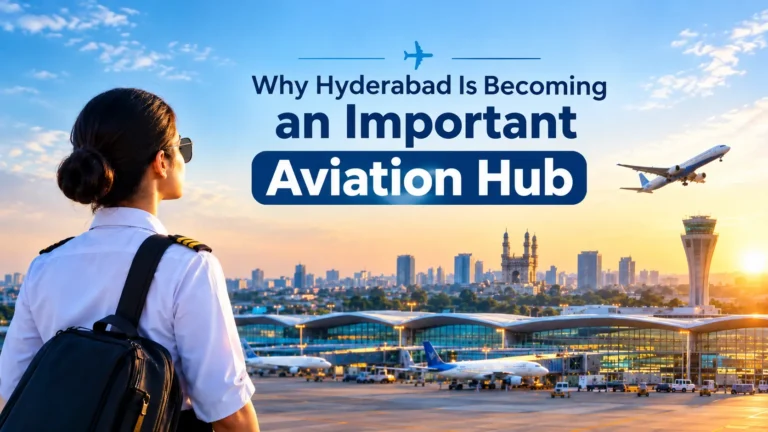
Hyderabad is quietly becoming one of India’s most important aviation hubs. Not only because it has a major international airport, but because the city is building the kind of ecosystem aviation needs: airport infrastructure, cargo movement, aerospace manufacturing, MRO capability, training institutions, engineering talent, and growing student interest in pilot careers.
For aviation aspirants, this matters.
Aviation careers are not built only inside aircraft. They are built inside ecosystems. A strong airport city creates exposure, awareness, training opportunities, technical jobs, airline operations, maintenance facilities, logistics roles, and eventually, stronger pathways for students who want to enter aviation professionally.
Rajiv Gandhi International Airport has become one of Hyderabad’s biggest aviation strengths. The airport handled over 30 million passengers and more than 182,000 tonnes of cargo during April 2025 to March 2026, according to available airport traffic data. It also has two runways, a cargo terminal, aviation training facilities, a fuel farm, solar power infrastructure, and MRO facilities.
That kind of infrastructure is not just good for travellers. It creates a foundation for aviation careers.
When passenger traffic grows, airlines need stronger operations. When cargo grows, logistics and air freight expertise become important. When aircraft movement increases, maintenance, ground handling, safety, dispatch, and airport management roles become more relevant. When MRO and aerospace activity expand, technical aviation careers become more visible.
This is why Hyderabad’s aviation story is bigger than the airport terminal.
The GMR Aerospace and Industrial Park near Hyderabad airport is another major reason the city is becoming important. It houses aviation and aerospace-related activity, including GMR Aero Technic, which provides aircraft maintenance, repair, and overhaul services. GMR’s own description says the aerospace park benefits from airport proximity, logistics access, academic talent, aviation training, and MRO infrastructure.
That is a serious advantage.
Aviation hubs are not built by one company or one training school. They are built when multiple parts of the industry are present in one place. Hyderabad now has airport operations, MRO capability, aerospace manufacturing presence, cargo connectivity, training infrastructure, and a large pool of engineering and technical talent.
The city has also attracted global aerospace names. GMR Aerospace Park has hosted major aerospace and industrial companies, including Safran, Pratt & Whitney, Skyroot Aerospace, and other engineering enterprises, and has been positioned as part of India’s larger aerospace manufacturing and MRO ambitions.
For students, this is important because aviation becomes easier to understand when it is visible around them.
A student in Hyderabad today is not looking at aviation as a distant dream. They can see the airport ecosystem. They can see aerospace activity. They can see pilot training conversations becoming more common. They can see airlines expanding, India’s aviation market growing, and Hyderabad becoming part of that larger story.
But this is also where students must be careful.
Just because Hyderabad is becoming an aviation hub does not mean aviation careers are easy. A growing ecosystem creates opportunity, but it does not reduce the seriousness of preparation.
To become a pilot, a student still needs clarity on eligibility, medical fitness, DGCA exams, ground classes, flying training, CPL planning, documentation, type rating, and airline readiness. The city may offer a stronger environment, but the student must still build the foundation.
This is where many aspirants make mistakes.
They see aviation growth and assume the path is simple. They get attracted to the uniform, cockpit photos, airport reels, and airline hiring news. But pilot training is not a social media dream. It is a disciplined, expensive, highly regulated career journey.
A serious student must ask better questions.
Am I medically fit?
Do I understand DGCA subjects?
Which flying training route suits my budget and timeline?
Should I train in India or abroad?
What happens after CPL?
How do I prepare for type rating and airline selection?
What skills do airlines expect beyond flying hours?
These questions matter more than excitement.
Hyderabad’s advantage is that students can now access better aviation awareness, stronger guidance conversations, and a more relevant local ecosystem. But awareness alone is not enough. The student needs a roadmap.
At Aviate Aero Academy, this is the gap we focus on. As a Hyderabad-based aviation training and guidance academy, Aviate Aero Academy supports aspiring pilots with DGCA ground classes, CPL guidance, flying training assistance, type rating guidance, and global flying school guidance. Our aim is to help students and parents move from confusion to clarity, especially before they make major financial and career decisions in aviation.
Hyderabad’s rise as an aviation hub also matters for parents.
For many families, pilot training is a big emotional and financial decision. Parents want to support the dream, but they often do not know which advice to trust. A stronger aviation ecosystem gives them more access to information, but it also increases the need for careful decision-making. More options can create more confusion if there is no proper guidance.
The truth is simple: Hyderabad is becoming important because aviation is no longer only about flights taking off and landing. It is about the entire chain behind those flights — training, maintenance, logistics, manufacturing, safety, operations, and skilled professionals.
For young pilots, that is a powerful signal.
The aviation future is getting closer to home.
But the cockpit will still belong only to those who prepare seriously. Hyderabad can create the environment. Institutes can provide guidance. Airports and aerospace companies can create visibility. But the student must bring discipline, clarity, and long-term commitment.
Hyderabad is rising as an aviation hub.
Now aviation aspirants must rise to the level this industry demands.