
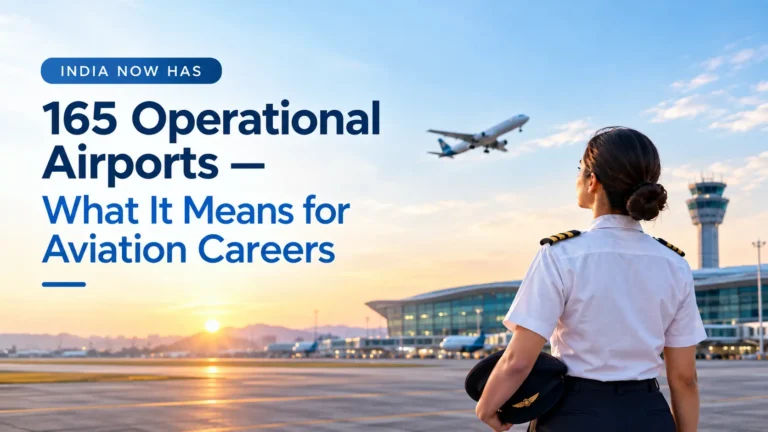
India Now Has 165 Operational Airports — What It Means for Aviation Careers
By Shravya, Aviate Aero Academy
For many years, aviation in India was seen as a career connected mainly to big cities. Delhi, Mumbai, Bengaluru, Hyderabad, Chennai, and Kolkata were the obvious centres of opportunity. If a student from a smaller city dreamed of becoming a pilot or entering aviation, the path often felt distant, expensive, and unfamiliar.
That picture is changing.
India now has 165 operational airports, up from 74 in 2014, according to the Ministry of Civil Aviation. The government has also highlighted that UDAN has helped expand regional connectivity, with routes connecting underserved and unserved airports across the country. (Press Information Bureau)
This is not just an infrastructure update. It is a career signal.
When airports increase, aviation does not grow only in the sky. It grows on the ground, in classrooms, in training centres, in maintenance hangars, in airport operations, in dispatch rooms, in safety departments, in customer service teams, and eventually, in cockpits.
For young aviation aspirants, this matters deeply.
A larger airport network means more cities are entering the aviation map. Regional routes create new passenger demand. Airlines need to evaluate new sectors. Airports need trained ground staff, operations teams, safety personnel, airside coordination teams, security systems, and technical support. As networks expand, the ecosystem around aviation becomes wider.
But students must be careful not to misunderstand the opportunity.
More airports do not automatically mean instant jobs for everyone who likes aviation. Growth creates possibilities, but readiness decides who benefits from those possibilities.
That is the difference between being inspired and being prepared.
India’s airport expansion has been supported by regional connectivity initiatives such as UDAN, which is focused on improving access to air travel in underserved and unserved regions. The Modified UDAN scheme has been approved for FY 2026–27 to FY 2035–36 with an outlay of ₹28,840 crore and a vision to develop more airports and helipads over the next decade. (Press Information Bureau)
This tells us that aviation careers in India will not remain limited to traditional metro-driven thinking. The next phase of growth may come from Tier-II and Tier-III cities, regional airports, smaller routes, and new travel demand from places that were earlier disconnected or underserved.
For pilot aspirants, this is important.
When regional aviation grows, the requirement for trained pilots, instructors, dispatch professionals, maintenance teams, and airport operations specialists can also increase over time. But airline cockpits will not be filled by students who only read growth headlines. They will be filled by students who build strong foundations early.
A student who wants to become a pilot must understand the complete journey: eligibility, medical fitness, DGCA subjects, computer number, ground classes, flying school selection, CPL training, documentation, type rating, simulator preparation, and airline readiness.
This is where many families get confused.
They see airport growth and assume the aviation career path is becoming easy. It is not becoming easy. It is becoming larger. That is a different thing.
Aviation remains a demanding profession. It needs discipline, technical knowledge, communication skills, decision-making ability, fitness, emotional maturity, and financial planning. A student cannot casually enter this field and expect the industry to carry them forward.
The industry may expand, but standards will remain high.
In fact, as Indian aviation becomes bigger, standards may become even more important. More airports mean more movements, more passengers, more operational complexity, and greater safety responsibility. The Ministry of Civil Aviation’s current data also shows India has 36 international airports, 118 domestic airports, and 63 operational bases for Flying Training Organisations, along with 41 FTOs. (Ministry of Civil Aviation)
That training ecosystem is critical because infrastructure alone cannot build aviation talent. Airports can be constructed. Aircraft can be purchased. Routes can be announced. But pilots and aviation professionals must be trained with patience, structure, and quality.
This is where students need to make better choices.
Do not choose aviation only because it looks glamorous.
Do not choose pilot training only because airlines are growing.
Do not choose a flying school only because the fee looks lower.
Do not delay medical checks.
Do not underestimate DGCA subjects.
Do not depend only on random online advice.
The smarter approach is to build clarity first.
At Aviate Aero Academy, we see this confusion every day. Students come with the dream of becoming pilots, but many do not know where to begin. Parents want to support them, but they often do not know which training path is reliable, what the actual cost looks like, or how long the journey may take. As a Hyderabad-based aviation training and guidance academy, Aviate Aero Academy supports students with DGCA ground classes, CPL guidance, flying training assistance, type rating guidance, and global flying school guidance. Our focus is to help aspirants move from confusion to clarity with a proper pilot career roadmap.
The rise to 165 operational airports should motivate students, but it should also make them more serious.
Because aviation growth will create more visibility, and with visibility comes competition. More students will enter the field. More institutes will advertise aviation careers. More families will explore pilot training. But only those who prepare correctly will move ahead with confidence.
For young aspirants, the message is simple: India’s aviation map is expanding. Your preparation must expand with it.
Learn the process. Understand the requirements. Build your foundation. Ask the right questions. Respect safety. Choose guidance over guesswork.
India’s airport growth is a powerful sign of the country’s aviation future.
But the future will not belong to everyone who dreams of flying.
It will belong to those who prepare with discipline before the opportunity arrives.