What Are DGCA Ground Classes? A Complete Guide for Hyderabad Students (2026)
If you’ve just finished 12th and you’re serious about becoming a commercial pilot, you’ve probably come across the term “DGCA ground classes” more times than you can count. Every aviation academy website mentions it. Every pilot you talk to brings it up. But almost nobody explains what it actually means, how long it takes, or what you’re supposed to do with it once you’re done.
This guide breaks it down in plain language — what DGCA ground classes are, why they matter, what subjects you’ll study, and how to choose the right training path if you’re based in Hyderabad or planning to study here.
What Are DGCA Ground Classes?
The Directorate General of Civil Aviation (DGCA) is India’s civil aviation regulator. Before you’re allowed to fly as a Commercial Pilot in India, you need to clear a set of theory examinations conducted by the DGCA. Ground classes are the structured coaching that prepares you for these exams.
Think of it as the academic backbone of your pilot training. While flying training teaches you to actually handle an aircraft, ground classes teach you the science, regulations, and technical knowledge every pilot is expected to know before they’re allowed near a cockpit.
Without clearing your DGCA exams, you cannot convert your flying hours into a valid Commercial Pilot License (CPL). That’s why most students start ground classes either right after 12th or alongside their initial flying training, rather than treating it as an afterthought.
Why DGCA Ground Classes Matter So Much
A lot of students underestimate the ground classes stage because it feels less “exciting” than actually flying. That’s a mistake. Here’s why:
- The DGCA exams have a reputation for being tough, with detailed, application-based questions rather than simple memorisation.
- Your CPL cannot be issued until all required DGCA papers are cleared — flying hours alone are not enough.
- The concepts you learn here — aircraft systems, meteorology, navigation — are things you’ll rely on for the rest of your flying career, not just for an exam.
- Airlines and flying schools often look at your ground subject performance as an early indicator of how disciplined and exam-ready you are.
In short, ground classes aren’t a formality before the “real” training starts. They are a core part of becoming a safe, competent pilot.
Subjects Covered in DGCA Ground Classes
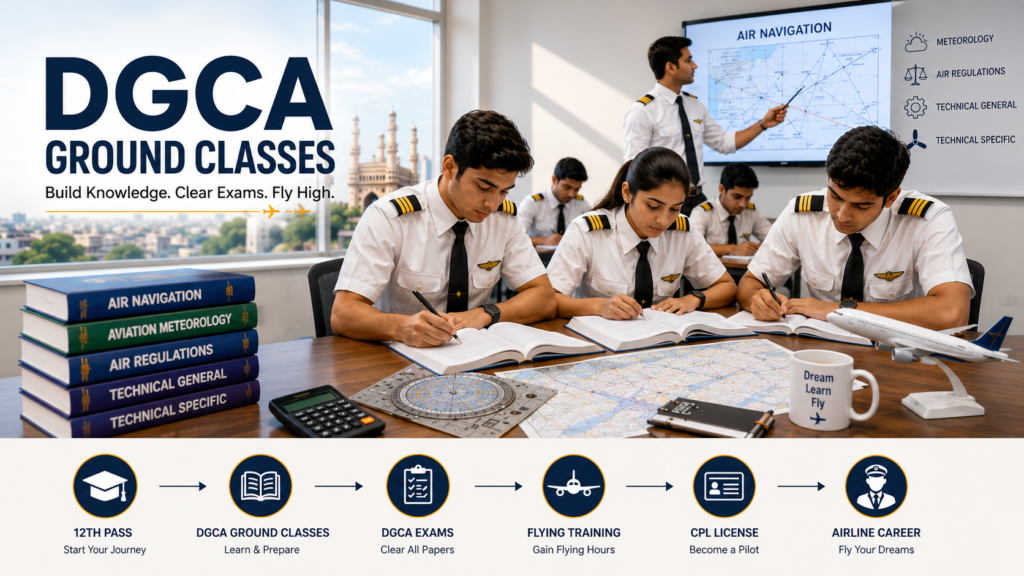
The DGCA CPL syllabus is divided into a few core papers. While exact groupings can be updated by the regulator from time to time, students preparing for their Commercial Pilot License typically study:
- Air Navigation — understanding flight paths, charts, and position calculations
- Aviation Meteorology — how weather systems affect flight planning and safety
- Air Regulations — the legal and procedural framework pilots must follow
- Technical General — aircraft systems, engines, and instruments
- Technical Specific — subject knowledge specific to the aircraft type you’re training on
Each of these papers demands a different kind of thinking. Meteorology is closer to applied science, air regulations is closer to legal reasoning, and navigation involves a fair amount of calculation. This is exactly why good ground classes rely on subject-focused faculty rather than one instructor trying to cover everything.
IndiGo, as an example, operates more than 350 aircraft on a dense domestic schedule. Before the FDTL update, a given number of pilots could legally service that schedule within the old rest and duty parameters. After the update, covering the same schedule with compliant rosters requires meaningfully more crew — estimates from aviation consultancy firm CAPA India place the incremental pilot demand from FDTL tightening alone at hundreds of additional positions across the Indian industry.
The cumulative effect of fleet expansion plus FDTL-driven incremental demand is a structural pilot shortage that persists regardless of economic conditions. Airlines cannot reduce their need for pilots without either grounding aircraft or violating safety regulations. Both outcomes are unacceptable — meaning the demand for qualified, licensed, type-rated pilots in India is as structurally secure as any professional demand in the country.
For a broader view of how India’s aviation expansion is driving pilot demand — including fleet orders, UDAN scheme growth, and CAPA projections — read our aviation boom 2026 career guide.
How Long Do DGCA Ground Classes Take?
There’s no single fixed timeline, since it depends on how many subjects you’re attempting together, your study pace, and how the exams are scheduled. As a general guide, most students complete their DGCA ground preparation over several months of structured classes, combined with regular mock tests and revision cycles.
Students who treat this stage casually often end up repeating attempts, which costs more time and money than doing it properly the first time. A structured, exam-focused approach — rather than rushed, last-minute preparation — tends to produce far better results.
DGCA Ground Classes vs Flying Training — What's the Difference?
It’s common for 12th-pass students to confuse these two stages, so it’s worth being clear:
- Ground classes are classroom-based theory training that prepares you for DGCA written exams.
- Flying training is hands-on training with an aircraft, usually at a flying school in India or abroad, where you log actual flying hours.
Both are required for your CPL. Many students complete ground classes in India first, since it’s often more cost-effective and lets you clear the theory papers before committing to expensive flying hours abroad or at Indian flying schools.
How to Choose the Right DGCA Training Institute in Hyderabad
If you’re searching for a DGCA training institute in Hyderabad, here are a few honest questions worth asking before you enrol anywhere:
- Do they have faculty with real aviation or exam-coaching background for each subject, or is one instructor teaching everything?
- Is there a structured schedule with regular mock tests, or is it open-ended coaching with no clear roadmap?
- Do they offer genuine career counselling — including realistic timelines and costs — or do they only focus on enrolment?
- Can they clearly explain what happens after ground classes: flying school options, documentation, and the CPL process?
- Do they have a track record of students who’ve actually gone on to pursue flying training?
A good academy won’t just teach you to clear exams — it will help you understand the full journey from 12th standard to CPL, so you’re making informed decisions at every step.
What Happens After DGCA Ground Classes?
Once you clear your DGCA papers, the next steps typically involve:
- Choosing a flying school in India or abroad based on your budget, timeline, and country preferences
- Completing your required flying hours and practical training
- Applying for your Commercial Pilot License (CPL) once all requirements are met
- Working towards a type rating once you’re closer to airline recruitment, based on the aircraft type you’ll be trained on
This is why career guidance matters just as much as classroom teaching. Passing your DGCA exams is a major milestone, but it’s one part of a longer, well-defined pathway — not the finish line.
A Note on Realistic Expectations
Becoming a commercial pilot is a genuinely achievable goal for a disciplined 12th-pass student, but it does involve time, consistent effort, and a real financial and academic commitment. Be cautious of anyone who promises guaranteed airline jobs right after ground classes — no institute can promise that, since airline hiring depends on many factors beyond ground training alone. What a good academy can promise is proper preparation, honest guidance, and support at every stage of the process.
Final Thoughts
DGCA ground classes are where your aviation career actually begins — not just academically, but in terms of building the discipline and technical foundation you’ll carry through flying training and, eventually, your career as a pilot. If you’re a 12th-pass student in Hyderabad exploring your options, take time to understand the syllabus, ask the right questions before choosing an academy, and treat this stage with the seriousness it deserves.
At Aviate Aero Academy, we work with students from the very beginning — helping them understand the DGCA syllabus, plan their ground classes, and map out a realistic pathway from 12th standard to CPL. If you’re exploring pilot training after 12th in Hyderabad, a free counselling session is a good place to start.
Book Your Free Country Selection Counselling — aviateaeroacademy.com/contact-us | +91 62816 37703