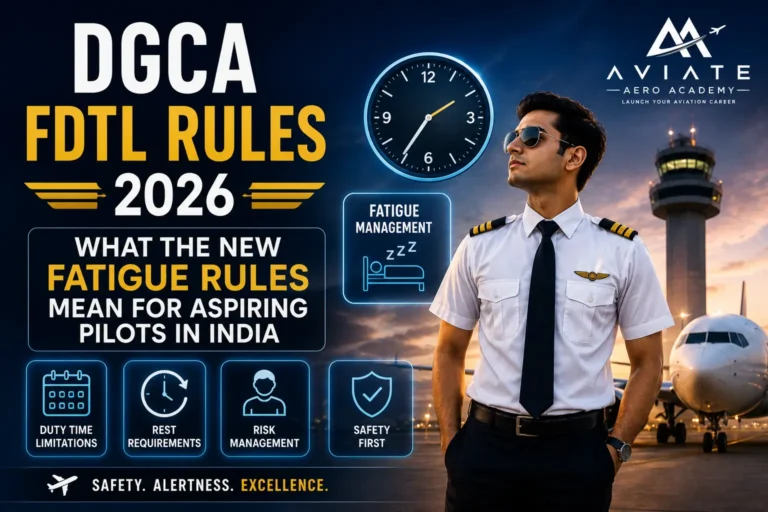
DGCA FDTL Rules 2026 — What the New Fatigue Rules Mean for Aspiring Pilots in India
In early 2024, India’s civil aviation regulator — the DGCA — introduced updated Flight Duty Time Limitation rules for commercial airline pilots. The change was driven by a growing body of aviation safety research linking pilot fatigue to degraded decision-making and increased incident risk. But the implications of those regulatory changes extended well beyond the cockpit — they created a structural shift in how many pilots Indian airlines need to operate the same number of flights.
For students currently preparing for their CPL, for parents evaluating the long-term stability of an aviation career, and for CPL holders thinking about the timing of their airline applications, the FDTL update is one of the most consequential regulatory changes in Indian aviation in recent years. This article explains what FDTL rules are, what changed in the 2024–2026 updates, and why the change directly affects pilot demand — and therefore pilot career opportunity — in 2026 and beyond.
What FDTL Actually Means — and Why It Exists
FDTL stands for Flight Duty Time Limitations. It is the regulatory framework that governs how many hours a commercial pilot can fly, how many hours they must rest between duty periods, and how their cumulative fatigue is managed over days, weeks, and months of airline operations.
The underlying principle is straightforward: a fatigued pilot is a safety risk. Fatigue impairs reaction time, decision-making accuracy, situational awareness, and the ability to manage unexpected events — precisely the capabilities most critical during high-workload phases of flight such as approach, landing, and emergency procedures. Aviation safety research, including studies conducted by ICAO, the FAA, and EASA, has consistently demonstrated that accumulated fatigue in flight crew is one of the most significant contributing factors in aviation incidents and accidents globally.
FDTL rules are the regulatory response to this risk. They define the legal boundaries within which airlines must schedule their pilots — and they make it an airline’s legal obligation, not just a good practice, to ensure their crews are rested.
ICAO’s standards on Fatigue Risk Management Systems are documented in Annex 6 and the associated guidelines — see ICAO Fatigue Management resources for the international framework that DGCA rules are aligned to.
What the DGCA Updated — The Key Changes in 2024–2026
India’s previous FDTL framework had been in place for many years and was considered by aviation safety specialists to be less restrictive than international benchmarks set by ICAO, EASA, and the FAA. The updated DGCA FDTL rules introduced in 2024 and further clarified through 2026 brought India significantly closer to international standards across several key parameters.
Reduced Maximum Flight Duty Period
The maximum number of consecutive hours a pilot can be on duty — from reporting time to end of last sector — was tightened. Where pilots previously could be rostered for longer duty periods, the updated rules impose stricter ceilings that reduce the maximum window within which airlines can schedule flight crew. The practical effect is that airlines can extract fewer flight hours from each pilot per duty period than they could under the previous framework.
Increased Minimum Rest Requirements
The minimum rest period between consecutive duty periods was extended. Pilots must now have a longer uninterrupted rest window before being rostered for their next flight duty. For airlines that operate high-frequency domestic networks — IndiGo with its 1,900+ daily flights, for instance — this change directly affects how tightly crew rosters can be packed. Airlines that previously scheduled minimum-rest turnarounds must now build more buffer into their crew planning.
Tighter Cumulative Hour Limits
The updated rules also tightened the cumulative flight hours a pilot can accrue over 28-day and 12-month rolling periods. This reduces the total volume of flying that each pilot can legally contribute to an airline’s operation over any given period — meaning that to maintain the same flight schedule, airlines need more pilots in their workforce.
How FDTL Changes Directly Increased Pilot Demand in India
Indian airlines were already facing a pilot supply gap driven by aggressive fleet expansion — IndiGo’s 500+ aircraft on order, Air India’s 470-aircraft Tata Group order, Akasa Air’s 220+ Boeing 737 MAX commitments. The FDTL update added a second, independent driver of pilot demand on top of the fleet expansion: the same fleet now requires more pilots per aircraft to remain legally compliant with the updated duty and rest rules.
IndiGo, as an example, operates more than 350 aircraft on a dense domestic schedule. Before the FDTL update, a given number of pilots could legally service that schedule within the old rest and duty parameters. After the update, covering the same schedule with compliant rosters requires meaningfully more crew — estimates from aviation consultancy firm CAPA India place the incremental pilot demand from FDTL tightening alone at hundreds of additional positions across the Indian industry.
The cumulative effect of fleet expansion plus FDTL-driven incremental demand is a structural pilot shortage that persists regardless of economic conditions. Airlines cannot reduce their need for pilots without either grounding aircraft or violating safety regulations. Both outcomes are unacceptable — meaning the demand for qualified, licensed, type-rated pilots in India is as structurally secure as any professional demand in the country.
For a broader view of how India’s aviation expansion is driving pilot demand — including fleet orders, UDAN scheme growth, and CAPA projections — read our aviation boom 2026 career guide.
What FDTL Rules Mean for Pilots Actually Working in Airlines
For pilots currently employed at Indian airlines, the FDTL update means better-protected rest periods and legal safeguards against the roster pressure that was a well-documented complaint in Indian aviation before the rule change. Pilots have a clearer regulatory basis for flagging duty periods that approach the limits and a more defined framework for managing their own fatigue.
The flip side — acknowledged honestly by experienced pilots — is that tighter duty limits can mean less take-home pay in months where overtime and additional sectors previously supplemented base salary. Airlines working with more pilots per aircraft, spread across the same total flight hours, may distribute earnings differently than under the previous system. This is a career reality worth understanding before joining, not a surprise to encounter after.
The overall assessment from India’s pilot community is strongly positive toward the FDTL updates. Fatigue-related incidents are one of the most preventable categories in aviation safety — and a regulatory framework that takes pilot fatigue seriously is one that takes pilot lives and passenger lives seriously. That is the purpose of the regulation, and it is one the vast majority of commercial pilots in India support.
What FDTL Rules Mean If You Are an Aspiring Pilot in 2026
If you are currently preparing for your CPL, or in the process of planning your pilot training journey, the FDTL update is relevant to your career planning in several specific ways.
- It reinforces the career stability argument: Pilot demand in India is now driven by two independent forces — fleet expansion and regulatory compliance requirements. Neither is going away. The structural case for starting pilot training in 2026 is stronger than it has been at any previous point in Indian aviation history.
- It raises the bar on airline readiness: Airlines operating under tighter FDTL rules have less capacity to accommodate pilots who need extended transition periods before line operations. Being well-prepared for airline selection — technically strong, medically current, documentation clean — matters more than ever because airlines want pilots who can contribute to rosters immediately.
- It validates the importance of DGCA ground class quality: Air Regulations is one of the five DGCA written examination subjects. FDTL rules fall within the regulatory knowledge that Air Regulations tests. Students who understand the framework — not just memorise the numbers — perform better in both DGCA exams and airline technical assessments.
- It makes the Type Rating decision more time-sensitive: With airlines actively hiring to meet FDTL-compliant roster requirements, the window between CPL issuance and active airline recruiting is shorter than it has historically been. Have your Type Rating plan in place before your CPL skill test, not after.
The Key FDTL Numbers Aspiring Pilots Should Know
Without reproducing the full regulatory text — which is available directly from the DGCA — here are the headline parameters from India’s updated FDTL framework that appear in DGCA Air Regulations examination questions and airline technical assessments:
- Maximum Flight Duty Period (FDP): Varies by number of sectors and time of day. Day FDPs are permitted to be longer than night FDPs. Extensions are permitted under specific conditions with additional rest requirements.
- Minimum Rest Period: The rest period between duty periods must be at least as long as the preceding duty period, subject to a defined minimum floor. Night rest periods have specific protections.
- Maximum flying hours — 28-day rolling: Pilots cannot exceed the prescribed cumulative flying hour limit in any rolling 28-day period.
- Maximum flying hours — 12-month rolling: A separate annual cumulative limit governs total flying hours across any 12-month period.
- Fatigue reporting: DGCA regulations now include clearer provisions for pilots to report fatigue without professional repercussion — an important safety mechanism that the updated framework strengthens.
The complete DGCA FDTL regulations are published on the official DGCA website — dgca.gov.in. DGCA Civil Aviation Requirements (CAR) Series F, Part II covers Flight Crew Licensing including duty time rules.
Regulations That Protect Pilots Also Create Careers
The DGCA FDTL update is, at its core, a safety regulation. It exists to protect passengers and crew from the demonstrable risks of fatigue in commercial aviation. The fact that it simultaneously creates structural demand for more pilots is not a coincidence — it is what happens when a regulator takes safety seriously in a growing industry. More protected pilots means more pilots needed. More pilots needed means more cockpit seats opening for those who are qualified and prepared.
At Aviate Aero Academy in Hyderabad, we keep our DGCA ground coaching current with every regulatory update — including FDTL changes that appear in Air Regulations examination papers and airline technical assessments. Students who understand the regulatory environment they are entering, not just the syllabus they are being tested on, arrive at airline selection better prepared than those who treat DGCA study as a checkbox exercise. The first counselling session is free.
Book Your Free Country Selection Counselling — aviateaeroacademy.com/contact-us | +91 62816 37703