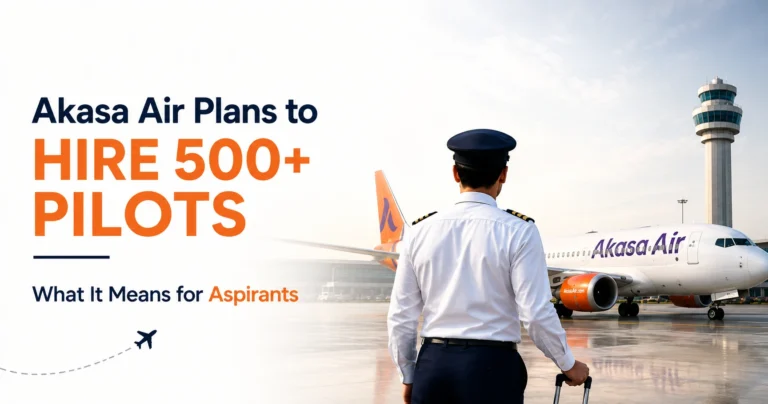
Akasa Air Plans to Hire 500+ Pilots — What It Means for Aspirants
By Shravya, Aviate Aero Academy
Every time an airline announces pilot hiring, aviation aspirants feel a sudden rush of hope. Parents start asking questions. Students begin imagining the uniform, the cockpit, the airline ID card, and the first flight as a professional pilot.
Akasa Air’s reported plan to hire more than 500 pilots over the next three years is one such moment. The airline is also expected to add more than a dozen aircraft annually during this period, while increasing its international aircraft deployment.
For India’s aviation industry, this is a strong signal.
For students, it is an opportunity.
But let us be honest: an airline hiring announcement does not automatically make every aviation aspirant ready for the cockpit.
The bigger question is not, “Are airlines hiring?”
The real question is, “Are students preparing correctly for the opportunity?”
India’s aviation sector is going through one of its most important growth phases. More aircraft are entering airline fleets. Domestic travel is expanding. International routes are becoming more important for Indian carriers. New airports and regional connectivity are changing how India flies. With this growth, the demand for trained pilots is naturally increasing.
But there is a gap that many students and parents do not see clearly enough.
Airlines may need pilots, but they do not need half-prepared aspirants.
They need candidates who have completed the right training, understood the regulatory pathway, built discipline, cleared the required exams, gained flying experience, and developed the maturity expected inside a modern cockpit.
This is where many students make a mistake. They see a hiring headline and immediately think the road is simple. Join a course, finish flying hours, get a licence, and apply.
The actual journey is more demanding.
A student who wants to become an airline pilot must first understand eligibility, DGCA requirements, medical fitness, ground subjects, flying school selection, CPL timelines, cost planning, documentation, type rating, and airline preparation. Missing clarity in even one of these stages can create delays later.
The cockpit is not reached through excitement alone. It is reached through structure.
Akasa Air’s hiring plans should motivate students, but they should also make them more serious. When airlines expand, competition also rises. More students enter the race. More families start exploring aviation. More aspirants apply for limited opportunities.
In that environment, casual preparation will not work.
A future-ready pilot needs more than flying hours. Flying hours matter, but they are only one part of the journey. A serious aspirant also needs strong technical knowledge, confidence in DGCA subjects, communication skills, decision-making ability, situational awareness, and professional discipline.
Airlines are not only evaluating whether someone can fly an aircraft. They are evaluating whether that person can operate safely, communicate clearly, follow procedures, handle pressure, and work inside a crew environment.
That is a different level of readiness.
Many aspirants underestimate DGCA ground preparation. They think flying is the “real” part and theory is just an exam hurdle. That mindset is dangerous. Aviation theory is not academic decoration. It is the foundation of decision-making in the air.
Navigation, meteorology, air regulations, technical general, aircraft systems, and radio communication all shape how a pilot thinks. A weak foundation here can affect confidence throughout the journey.
Another mistake is choosing a flying school without proper research. Some students look only at cost. Some look only at location. Some get influenced by glossy marketing. Very few ask the harder questions: aircraft availability, instructor quality, flying timelines, weather conditions, maintenance standards, training consistency, documentation support, and actual student outcomes.
Pilot training is expensive. A wrong decision at the beginning can cost time, money, and confidence.
Parents also need to understand this clearly. Supporting a child’s aviation dream is not just about arranging funds. It is about ensuring the student follows the right roadmap. Aviation is a career where planning matters as much as passion.
This is where structured guidance becomes important.
At Aviate Aero Academy, our focus is to help students and parents move from confusion to clarity. As a Hyderabad-based aviation training and guidance academy, Aviate supports aspiring pilots with DGCA ground classes, CPL guidance, flying training assistance, type rating guidance, and global flying school guidance. Our role is not to sell a dream blindly. It is to help students understand the full pilot career path before they make serious academic, financial, and career decisions.
Akasa Air’s expansion is good news for Indian aviation. It reflects confidence in the market and opens meaningful possibilities for trained professionals. But students must understand that airline growth creates opportunity only for those who are ready when the door opens.
The student who starts early will have an advantage.
The student who understands the process will have an advantage.
The student who prepares with discipline will have an advantage.
The student who treats aviation as a profession, not just a dream, will have an advantage.
Hiring announcements should not create panic. They should create preparation.
If you are an aviation aspirant today, do not ask only, “When will airlines hire?”
Ask better questions.
Am I eligible?
Have I checked my medical fitness?
Do I understand the DGCA pathway?
Am I ready for ground subjects?
Do I know how to choose the right flying school?
Have I planned my CPL journey properly?
Do I understand what airlines expect beyond a licence?
These questions may not sound as exciting as a pilot recruitment headline, but they are the questions that decide who actually moves forward.
India’s aviation future is opening up. Akasa Air’s plan to hire more than 500 pilots is another reminder that the industry is growing and opportunities will come for those who prepare seriously.
But the cockpit will not belong to everyone who reads the headline.
It will belong to those who build the foundation, respect the process, and become ready before the opportunity arrives.