The Future of Air India: What Young Pilots Should Watch
By Shravya, Aviate Aero Academy
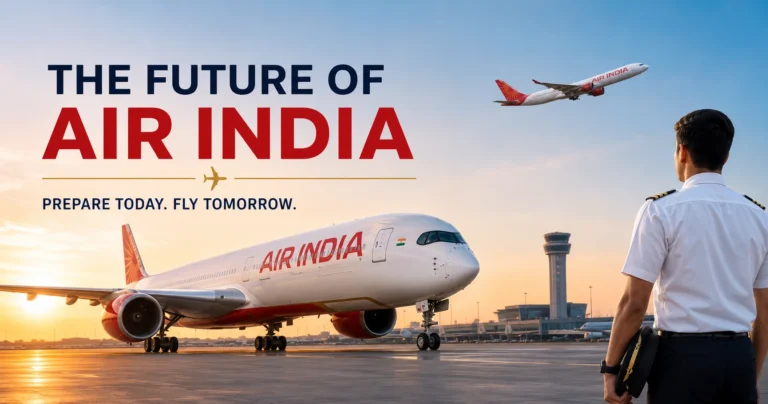
Air India is not just another airline story right now. It is one of the most important aviation transformation stories in India.
For young pilots, this matters.
Because when a national carrier changes its fleet, network, training systems, brand standards, customer experience, and global ambition, it does not only change how passengers fly. It changes what the next generation of pilots must prepare for.
Air India has been moving through a large transformation under its Vihaan.AI programme, with fleet modernisation, network expansion, cabin upgrades, operational improvements, and service reforms forming part of the wider plan. The airline had placed a landmark order for 470 aircraft from Airbus and Boeing in 2023, and later added another 100 Airbus aircraft, taking the total order to 570 aircraft.
That number is impressive. But students should not look at aircraft orders only as a hiring signal.
They should look at them as a readiness signal.
More aircraft will need more pilots, yes. But modern aircraft also demand pilots who are technically sharp, disciplined, adaptable, and trained for global standards. The future Air India cockpit will not be built for casual aspirants. It will be built for professionals who understand that aviation is changing faster than the old training mindset.
Air India is also upgrading its long-haul product and international operations. The airline has said that by the end of 2026, more than half of its long-haul flights will operate with upgraded aircraft, and by 2029, the full long-haul fleet is expected to be upgraded. It also expects deliveries of new Boeing 787-9 and Airbus A350-1000 aircraft as part of its product and fleet improvements.
For a passenger, this means better seats, better cabins, and a stronger international experience.
For a pilot aspirant, it means something deeper: India’s airline careers are becoming more global, more complex, and more demanding.
Flying for a modern full-service airline is not only about holding a licence. It is about operating in an ecosystem where training quality, simulator exposure, crew coordination, safety culture, standard operating procedures, communication, and decision-making all matter.
This is where many students misunderstand the aviation journey.
They think the goal is to “become a pilot.” But that phrase is too vague. A student must ask: what kind of pilot am I preparing to become? Am I preparing only to complete CPL requirements, or am I preparing to be airline-ready? Am I studying only to pass DGCA exams, or am I building the foundation required for a professional cockpit? Am I chasing speed, or am I building competence?
Air India’s future will reward the second kind of student.
One major development young pilots should watch is Air India’s investment in training infrastructure. Air India and Airbus have set up an advanced pilot training hub at the Air India Training Academy in Gurugram. The facility is designed to train pilots for Airbus A320 and A350 aircraft families, includes full-flight simulators, advanced classrooms, and briefing rooms, and the courses are approved by DGCA and EASA. Airbus has also said the centre is expected to train more than 5,000 new pilots over the next decade.
This is not a small detail. It shows where the industry is going.
The next generation of pilots will not be trained only through traditional flying-hour completion. They will need stronger simulator-based preparation, aircraft-family familiarity, crew resource management, and global-standard training systems. A pilot who understands only the minimum requirements will fall behind. A pilot who understands the bigger professional environment will have an advantage.
But young pilots must also watch the difficult side of Air India’s future. Transformation is never smooth. Air India has faced operational challenges, regulatory scrutiny, financial pressure, airspace disruptions, and delays in parts of its modernisation journey. Reuters recently reported that the airline’s leadership faces major challenges around safety, compliance, losses, fleet modernisation, and ongoing restructuring.
This is important because aviation students often consume only the glamorous side of airline news. They see new aircraft, new uniforms, new routes, and recruitment headlines. But aviation is also about resilience, safety, regulation, crisis management, and operational discipline.
A strong pilot must understand both sides.
Aviation is not Instagram. It is not only aircraft photos and uniform dreams. It is a profession where one weak decision, one ignored procedure, one careless assumption, or one poor judgement can have serious consequences.
That is why young pilots should watch Air India not only for job opportunities, but also for lessons.
Watch how it modernises its fleet.
Watch how it trains pilots.
Watch how it manages safety expectations.
Watch how it builds international routes.
Watch how it responds to disruption.
Watch how it integrates global standards into Indian aviation.
These are not just business updates. They are signals of what the future Indian pilot must become.
At Aviate Aero Academy, we often meet students who are excited by airline growth but confused about the actual path. As a Hyderabad-based aviation training and guidance academy, Aviate Aero Academy supports aspiring pilots with DGCA ground classes, CPL guidance, flying training assistance, type rating guidance, and global flying school guidance. Our focus is to help students and parents move from confusion to clarity, so they understand the complete pilot career roadmap before making serious financial and career decisions.
This clarity is essential now.
Because the Air India of the future will not need students who prepared casually. It will need pilots who respected the process from day one.
That means checking medical eligibility early. Taking DGCA subjects seriously. Choosing flying schools carefully. Understanding cost and timeline realistically. Building communication skills. Learning discipline. Preparing for simulator-based training. Understanding airline expectations beyond licence completion.
For parents, the message is equally important. Do not look at airline growth and assume the journey is simple. Pilot training is a serious investment. The right question is not, “How quickly can my child become a pilot?” The better question is, “How properly can my child be prepared for the airline cockpit?”
Air India’s future is a powerful sign of where Indian aviation is heading. The airline wants to become a stronger global carrier. Its fleet is changing. Its training ecosystem is growing. Its international ambitions are rising. Its transformation is complex, but its direction is clear.
For young pilots, this is the moment to become serious.
Not excited for one week after reading a headline.
Not motivated only by aircraft photos.
Not attracted only by the uniform.
Serious about the foundation.
The future of Air India will create opportunities, but it will also raise expectations. And in aviation, raised expectations are not a problem. They are a filter.
The students who prepare early, prepare correctly, and treat aviation as a responsibility-driven profession will be the ones ready for that future.
Air India is changing.
Now young pilots must change the way they prepare.