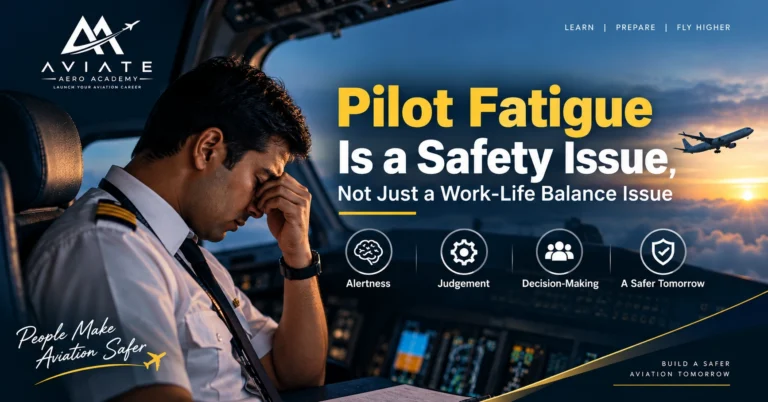
Pilot Fatigue Is a Safety Issue, Not Just a Work-Life Balance Issue
By Shravya, Aviate Aero Academy
When people talk about pilot fatigue, they often reduce it to lifestyle.
They imagine tired pilots needing more rest, better schedules, or improved work-life balance. All of that matters. But in aviation, fatigue is not only a personal wellness issue. It is a safety issue.
A tired pilot is not just an overworked employee. A fatigued pilot is a safety-sensitive professional operating in an environment where alertness, judgement, communication, memory, coordination, and decision-making can directly affect hundreds of lives.
That is why pilot fatigue must be discussed with seriousness, not sympathy alone.
The Directorate General of Civil Aviation defines fatigue as a physiological state of reduced mental or physical performance capability caused by sleep loss, extended wakefulness, circadian rhythm, or workload, which can impair a crew member’s alertness and ability to safely operate an aircraft.
That definition is important because it removes emotion from the conversation. Fatigue is not laziness. It is not weakness. It is not a pilot “complaining.” It is a measurable human-performance risk.
Aviation is built on discipline, but pilots are still human beings. They operate early mornings, late nights, multiple sectors, changing weather, delays, high workload environments, and sometimes disrupted sleep cycles. A pilot may look physically present in the cockpit, but fatigue can quietly reduce alertness and slow decision-making.
That is dangerous because aviation safety depends on small decisions made correctly, repeatedly, and often under pressure.
A missed callout.
A delayed reaction.
A checklist error.
A weak approach decision.
Poor communication during high workload.
Underestimating risk because the mind is tired.
These are not abstract concerns. Fatigue affects performance in ways that may not always be visible from the outside. The UK Civil Aviation Authority lists fatigue-related effects such as reduced alertness, memory lapses, degraded human performance, poor coordination, reduced ability to process information, errors, and underestimation of risk.
For a normal job, that may lead to reduced productivity.
In aviation, it can affect safety.
India has already recognised the seriousness of the issue. In January 2024, DGCA announced revised Flight Duty Time Limitations regulations to address pilot fatigue, enhance flight safety, and move towards a future Fatigue Risk Management System. The Ministry of Civil Aviation described FRMS as a data-driven approach to improve monitoring and reporting of flight crew fatigue.
This is the right direction because fatigue cannot be managed only by fixed rules on paper. Rules matter, but aviation is dynamic. Weather changes. Delays happen. Night operations affect the body differently. Long duty days and repeated schedule disruptions can create cumulative fatigue.
That is why global aviation bodies increasingly speak about fatigue management as a safety system, not just a rostering issue. ICAO explains fatigue management as the methods used by aviation service providers and operational personnel to address the safety implications of fatigue. IATA also notes that fatigue management can follow both prescriptive and performance-based approaches, supported by ICAO standards.
The key word here is safety.
Young pilots must understand this early. A professional pilot is not judged only by flying skill. A professional pilot is judged by discipline, honesty, decision-making, and respect for limits.
That includes knowing when fatigue is affecting performance.
Unfortunately, many aviation aspirants focus only on the glamorous parts of the profession. They think about aircraft, uniforms, airline jobs, international routes, and cockpit photos. They do not think enough about human factors, fatigue, sleep discipline, reporting culture, and operational responsibility.
That mindset must change.
The future pilot must learn that safety begins before entering the cockpit. It begins with lifestyle discipline, preparation habits, physical fitness, mental alertness, proper rest, and the maturity to take fatigue seriously.
This does not mean pilots should be afraid of demanding schedules. Aviation is a demanding profession. It will always involve irregular hours, responsibility, pressure, and sacrifice. But there is a difference between being committed and being unsafe.
Commitment is preparing well.
Unsafe culture is pretending fatigue does not exist.
At Aviate Aero Academy, we believe students must understand the profession honestly before they enter it. As a Hyderabad-based aviation training and guidance academy, Aviate Aero Academy supports aspiring pilots with DGCA ground classes, CPL guidance, flying training assistance, type rating guidance, and global flying school guidance. But beyond the technical pathway, we also help students understand the mindset required for aviation: discipline, safety awareness, responsibility, and respect for the realities of cockpit life.
This is especially important for parents too.
When a child says they want to become a pilot, families often ask about cost, flying school, eligibility, and job opportunities. Those are important questions. But they should also ask: does the student understand the seriousness of the profession? Are they ready for disciplined routines? Can they respect safety over ego? Can they handle pressure without carelessness?
Aviation does not need only dreamers. It needs responsible professionals.
Pilot fatigue reminds us that even the best machines depend on human performance. Aircraft may become more advanced. Cockpits may become more automated. Training may become more sophisticated. But the pilot’s alertness, judgement, and discipline will remain central to safety.
So, pilot fatigue should not be treated as a soft HR topic.
It should be treated as part of aviation safety culture.
A good pilot does not only know how to fly. A good pilot knows how to protect the flight.
And sometimes, protecting the flight begins with respecting the human limits of the person sitting in the cockpit.