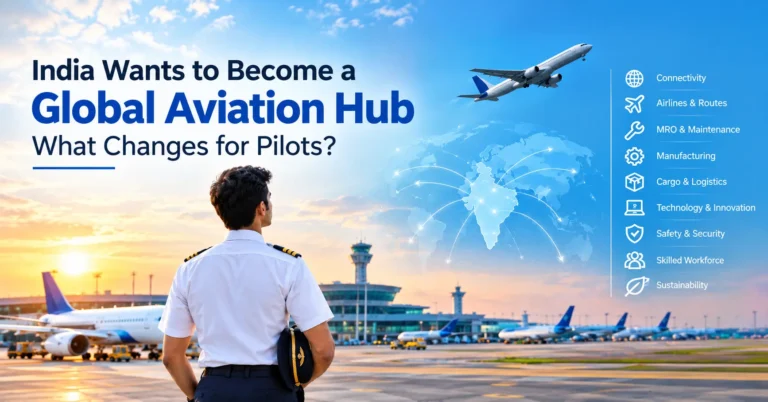
India Wants to Become a Global Aviation Hub — What Changes for Pilots?
By Shravya, Aviate Aero Academy
India’s aviation ambition is no longer limited to adding more flights or building more airports. The country is now speaking the language of a global aviation hub.
That is a much bigger idea.
A global aviation hub does not only mean passengers flying from one city to another. It means stronger international connectivity, long-haul airline networks, regional feeder routes, aircraft maintenance, pilot training, cargo movement, manufacturing, technology, safety systems, and a skilled aviation workforce that can support all of it.
At Wings India 2026, the government positioned India’s civil aviation sector as one of the fastest-growing in the world and highlighted the country’s ambition to become a global aviation powerhouse across connectivity, manufacturing, services, innovation, and sustainability.
For young pilots, this is exciting. But it also changes the level of preparation required.
Because when a country wants to become a global aviation hub, pilots cannot prepare with a local, minimum-requirement mindset anymore.
They must prepare for a larger, more demanding aviation ecosystem.
India already has important strengths. The Prime Minister has spoken about India’s geographic position in global air corridors, its domestic feeder network, future long-haul fleet expansion, and its potential to become a major aviation gateway between the Global South and the world.
For pilots, that means one thing clearly: Indian aviation careers are becoming more connected to international standards.
A future pilot may begin training in India, but the cockpit environment they enter will be shaped by global expectations. Airlines will need pilots who understand standard operating procedures, crew resource management, automation, communication discipline, international routes, fatigue management, safety culture, and simulator-based evaluation.
The old thinking was simple: clear DGCA exams, complete flying hours, get a licence, and wait for airline hiring.
That is not enough anymore.
A licence is important. Flying hours are important. DGCA preparation is important. But a global aviation hub needs pilots who are not only qualified on paper. It needs pilots who are professionally ready.
This shift will affect students from the beginning of their journey.
First, DGCA ground school will matter more, not less. Many students treat theory as an exam hurdle. That is a mistake. Navigation, meteorology, air regulations, technical knowledge, and radio communication are not just subjects. They are the foundation of a pilot’s decision-making ability.
Second, communication skills will become more important. A pilot working in a globally connected aviation system must communicate clearly, calmly, and professionally. English radio communication, cockpit coordination, briefing discipline, and the ability to explain technical understanding during interviews and simulator checks will all matter.
Third, simulator training and scenario-based thinking will carry more weight. Modern airline flying is not only about handling an aircraft in normal conditions. It is about managing abnormal situations, automation, crew coordination, weather decisions, and workload under pressure.
Fourth, students must understand the aviation ecosystem beyond the cockpit. India is also focusing on MRO, aircraft manufacturing, cargo logistics, digital air navigation, sustainable aviation fuel, and advanced air mobility. A pilot who understands the larger direction of the industry will think more maturely about their career.
This is where many aspirants will fall behind.
They will read headlines about India becoming an aviation hub and assume jobs will become easy. That is lazy thinking.
Growth creates opportunity, but it also raises competition. More students will enter aviation. More families will explore pilot training. More institutes will market aviation careers. Airlines will have more candidates to choose from.
The students who win will not be the loudest dreamers. They will be the best prepared.
Parents also need to understand this shift. Pilot training is a serious financial decision. If India is becoming a global aviation hub, the answer is not to rush into the nearest or cheapest flying school. The answer is to build a correct roadmap.
Is the student medically fit?
Are DGCA subjects being taken seriously?
Is the flying school reliable?
Is the cost structure realistic?
Is there clarity on CPL, type rating, simulator checks, and airline preparation?
Is the student building discipline, communication, and professional maturity?
These questions matter more than excitement.
At Aviate Aero Academy, we see this confusion every day. As a Hyderabad-based aviation training and guidance academy, Aviate Aero Academy supports aspiring pilots with DGCA ground classes, CPL guidance, flying training assistance, type rating guidance, and global flying school guidance. Our focus is to help students and parents move from confusion to clarity, so the pilot journey begins with structure, not guesswork.
India’s aviation future is becoming larger, more ambitious, and more global. That is a powerful opportunity for young pilots.
But opportunity will not reduce the seriousness of aviation.
It will increase it.
The cockpit of the future will need pilots who are technically strong, mentally disciplined, globally aware, and safety-focused. It will need students who start early, prepare correctly, and understand that aviation is not a shortcut career.
India may become a global aviation hub.
But the pilots who benefit from that future will be the ones who prepare like global professionals from day one.
For this blog, I’d use the following SEO setup. I’d keep the primary keyword focused on “pilot career in India” and use the global aviation hub angle as the supporting topic.