Can AI Prevent Runway Accidents?
By Shravya, Aviate Aero Academy
Runway accidents are among the most serious risks in aviation because they happen at the exact point where aircraft, vehicles, air traffic control, airport operations, weather, visibility, human judgement, and time pressure all meet.
A runway looks simple from a passenger window. To aviation professionals, it is one of the most safety-critical spaces in the entire airport.
Every take-off and landing depends on the runway being clear, correctly assigned, properly monitored, and safely used. A small misunderstanding can become serious very quickly. A wrong clearance, a vehicle entering the runway, an aircraft lining up on the wrong surface, poor visibility, unstable approach, wildlife presence, runway contamination, or communication breakdown can all create risk.
So the question is important: can artificial intelligence help prevent runway accidents?
The answer is yes, but not in the simplistic way people imagine.
AI can help reduce runway risk. It can improve monitoring, alerting, prediction, and decision support. But AI cannot replace aviation discipline, controller judgement, pilot responsibility, airport safety culture, and proper training.
Runway safety has been a global priority for years. ICAO’s Global Runway Safety Action Plan aims to reduce the global rate of runway excursions and runway incursions, and the second edition was released in February 2024. EUROCONTROL also describes runway incursions as one of aviation’s most persistent safety threats, noting that ICAO places runway incursions among the five highest-risk categories of events that must be addressed to reduce the possibility of aviation fatalities.
That tells us something clearly: runway risk is not a minor airport issue. It is a core aviation safety issue.
AI’s strongest role is situational awareness. At a busy airport, many movements happen at once. Aircraft taxi. Ground vehicles cross service roads. Maintenance teams operate near airside zones. Controllers monitor radio communication, radar displays, visual movement, weather, and changing instructions. Pilots manage checklists, aircraft configuration, taxi routing, and ATC communication.
In such an environment, AI-supported systems can help by constantly watching patterns that humans may miss.
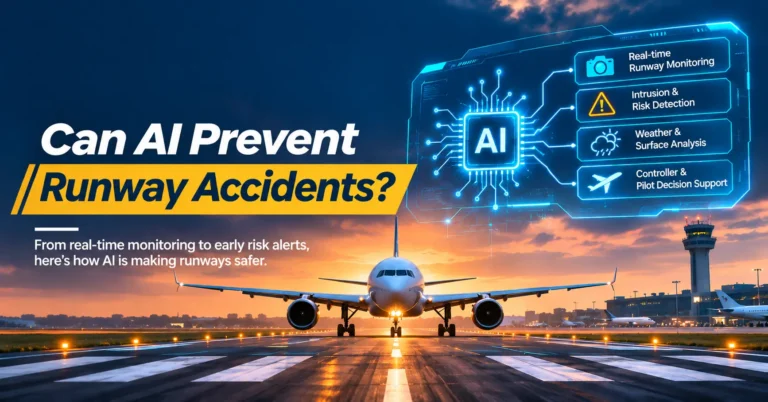
AI can analyse camera feeds, surface movement data, sensors, radar inputs, weather information, and historical incident patterns. It can detect abnormal movement, unauthorised runway entry, possible wrong-surface alignment, foreign object debris, wildlife presence, standing water, or operational conflicts. It can alert controllers or airport teams before a situation becomes critical.
The FAA’s Surface Safety Portfolio gives a strong example of where runway technology is heading. The FAA began installing Surface Awareness Initiative systems in June 2024 and planned to make SAI operational at 50 towers by the end of 2025. The goal is to give tower controllers better airport-surface awareness where visibility or surveillance is limited.
The FAA is also expanding Approach Runway Verification, a system that alerts controllers when an aircraft is not aligned with the runway surface it was cleared to land on. As of January 30, 2025, it was operational at 77 airports, with the FAA aiming to expand it further.
This is not AI replacing people. This is technology strengthening the safety net around human decision-making.
That distinction matters.
Aviation cannot afford blind faith in automation. If an AI system gives an alert, trained humans must still evaluate it. If the system misses something, humans must still maintain vigilance. If the system produces false alarms, the process must be refined. In aviation, every tool must be tested, validated, audited, and integrated into clear procedures.
AI can support safety, but accountability remains human.
For pilots, this is an important lesson. The cockpit of the future will likely receive more intelligent support from systems that detect risk earlier. But a good pilot cannot become passive because technology is watching. A pilot must still verify clearances, maintain situational awareness, listen carefully, question uncertainty, respect standard operating procedures, and communicate clearly.
For air traffic controllers, AI can act like an additional layer of attention. It can help identify conflicts faster, especially during low visibility or high workload. But controllers still need judgement, prioritisation, radio discipline, and the ability to make safe decisions under pressure.
For airport operators, AI can help with runway inspections, foreign object debris detection, pavement condition monitoring, wildlife monitoring, and predictive maintenance. Research and industry discussions increasingly point to AI’s potential in real-time sensing, forecasting, runway safety prediction, and airfield condition monitoring.
But the danger is assuming technology alone will solve runway accidents.
It will not.
Runway safety needs a complete system: trained pilots, alert controllers, disciplined airport operations, clear phraseology, strong runway signage and lighting, reliable surveillance, accurate weather reporting, proper maintenance, safety reporting culture, and continuous training.
AI is a powerful layer inside that system. It is not the system itself.
At Aviate Aero Academy, we believe aviation students must understand this reality early. As a Hyderabad-based aviation training and guidance academy, Aviate Aero Academy supports aspiring pilots with DGCA ground classes, CPL guidance, flying training assistance, type rating guidance, and global flying school guidance. But beyond the technical roadmap, we also help students understand the mindset aviation demands: safety awareness, discipline, communication, situational awareness, and respect for procedures.
Because future pilots will not work in the same aviation environment their seniors entered years ago. They will work in a more connected, more data-driven, more automated aviation ecosystem. AI will influence airport operations, maintenance, dispatch, weather planning, air traffic control support, and safety monitoring.
That does not reduce the pilot’s responsibility.
It increases the need for better judgement.
So, can AI prevent runway accidents?
AI can help prevent some accidents by detecting risk earlier, improving visibility, supporting controllers, assisting airport teams, and strengthening decision-making. But it cannot remove human responsibility from aviation.
The safest future will not come from AI alone.
It will come from trained humans using intelligent systems properly.
Runway safety will always depend on one principle: no technology should make aviation professionals less alert. The best technology should make them more aware, more prepared, and more capable of acting before risk becomes an accident.