Can AI Help Train Air Traffic Controllers?
By Shravya, Aviate Aero Academy
When students think about aviation careers, most of them immediately think about pilots.
That is natural. The cockpit is visible, aspirational, and emotionally powerful. But every safe flight also depends on another group of professionals who rarely get the same attention: air traffic controllers.
They are the voices guiding aircraft from pushback to take-off, through controlled airspace, into approach, landing, taxi, and parking. Their work is precise, fast, highly disciplined, and unforgiving of casual mistakes.
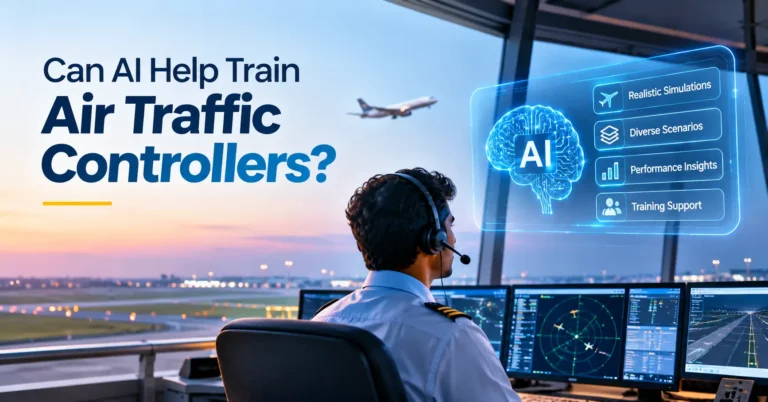
Now, as air traffic grows and aviation systems become more complex, one question is becoming more important: can artificial intelligence help train air traffic controllers?
The answer is yes, but with one important condition.
AI can support ATC training. It should not replace the seriousness, human judgement, and regulatory discipline that the profession demands.
Air traffic control training has always depended heavily on simulation. A trainee controller cannot learn only from textbooks because the real skill is built through live decision-making, radio communication, aircraft sequencing, conflict awareness, workload management, and pressure handling.
In India, the Airports Authority of India’s Civil Aviation Training College at Prayagraj is a key training establishment for air traffic control and CNS training. AAI describes CATC as a modernised training establishment with infrastructure, training facilities, laboratories, and simulators. It also notes that ATC and CNS training are highly safety-critical and regulated by DGCA and ICAO.
That safety-critical nature is exactly why AI must be used carefully.
AI can be powerful in simulation-based learning. In traditional ATC simulation, human “pseudo-pilots” or simulation pilots often play the role of aircraft on radio. They respond to trainee instructions, read back clearances, create realistic traffic flow, and help build scenario pressure. But this model is resource-heavy. It needs trained people, time, coordination, and repeated scenario design.
AI can reduce some of that burden.
Research has already explored AI-powered virtual simulation pilots for ATC training. One study proposed a virtual simulation-pilot engine using automatic speech recognition, language understanding, and text-to-speech to receive a trainee controller’s spoken instruction, understand it, and generate pilot-like readbacks. The system could even introduce deliberate read-back errors to train controllers to catch mistakes.
That is valuable because one of the hardest skills in ATC is not only giving instructions. It is listening carefully, detecting incorrect readbacks, correcting them quickly, and maintaining control of the situation.
AI can also help create more varied training scenarios. Instead of repeating the same limited traffic exercises, AI-supported tools can generate changing traffic patterns, unusual workload situations, communication challenges, runway conflicts, weather disruptions, and emergency scenarios. This could help trainees experience a wider range of situations before they face real operations.
The FAA has also been expanding simulation systems for controller training. In 2025, the FAA said it was installing more Tower Simulation Systems to certify air traffic controllers faster while reducing costs. Its research work has also explored tools such as CASPER, a computer-automated simulation pilot that uses automated speech recognition to improve realism and efficiency in human-in-the-loop ATC simulations.
This tells us something important: the future of ATC training will likely be more simulation-driven, more data-driven, and more technology-supported.
But it would be a serious mistake to call AI a shortcut.
ATC is not a video game. It is not only about moving aircraft icons on a screen. It is about building mental discipline. A controller must anticipate conflicts, manage traffic flow, communicate clearly, stay calm under pressure, prioritise tasks, recover from mistakes, and make decisions in seconds.
AI can create practice environments.
AI can evaluate communication patterns.
AI can simulate pilot responses.
AI can help instructors identify weak areas.
AI can make training more scalable.
But AI cannot remove the human responsibility at the centre of ATC.
In fact, AI may make training expectations higher. If trainees get better simulation exposure, instructors may expect them to arrive at operational training with stronger communication, sharper situational awareness, and better workload management.
This is the same lesson pilot aspirants must understand. Technology does not reduce the need for fundamentals. It exposes weak fundamentals faster.
A student who wants to enter aviation, whether as a pilot, controller, dispatcher, or engineer, must understand that the future industry will reward people who can work with technology without becoming dependent on it.
At Aviate Aero Academy, we see aviation as a complete ecosystem, not only a cockpit dream. As a Hyderabad-based aviation training and guidance academy, Aviate Aero Academy supports students with DGCA ground classes, CPL guidance, flying training assistance, type rating guidance, and global flying school guidance. But we also believe students must understand the wider aviation world around them: air traffic control, airport operations, MRO, safety systems, communication discipline, and the technology shaping future aviation careers.
For parents, this wider understanding matters. Not every aviation career is inside the cockpit, and not every student’s strength is flying. Some may be better suited for air traffic control, operations, dispatch, maintenance, or technical roles. India’s aviation growth will need all of them.
So, can AI help train air traffic controllers?
Yes, absolutely.
It can make training more realistic, more repeatable, more scalable, and more measurable. It can support instructors, improve simulation depth, and prepare trainees for complex communication and traffic situations.
But AI must remain a training partner, not the final authority.
Because aviation safety is built on human judgement, disciplined procedures, regulatory oversight, and accountability.
The future air traffic controller may train with smarter systems.
But the responsibility will still belong to the human being who clears an aircraft to fly.