Philippines vs India for Pilot Training — Complete Cost and Career Comparison 2026
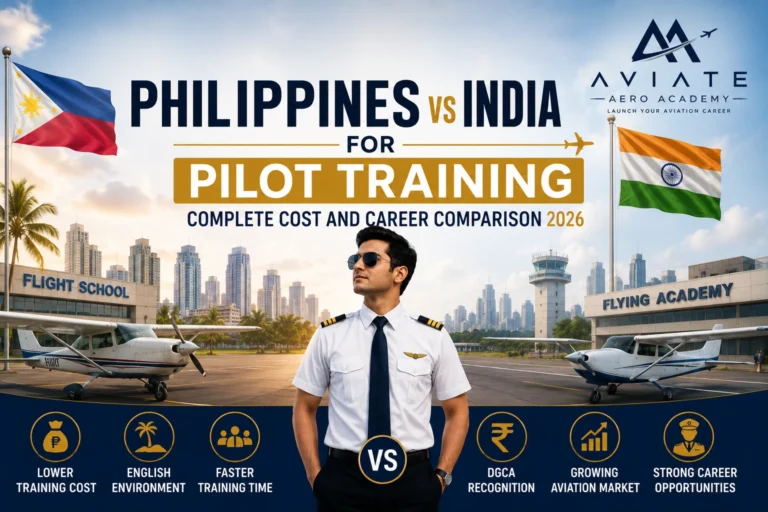
For most Indian CPL aspirants, the decision between training in India and training in the Philippines is one of the most significant choices of their pilot journey. Get it right and your training runs smoothly, your timeline stays on track, and you return with a clean license ready for DGCA conversion. Get it wrong — or worse, make the decision without complete information — and you face unexpected costs, training delays, and a conversion process that adds months to the timeline between your CPL and your first airline salary.
This comparison gives you the honest picture for 2026 — not a brochure for either option. Cost, weather, visa, training quality, DGCA conversion, and what each route means for your airline career in India.
The Core Difference — What You Are Actually Choosing Between
Training in India means attending a DGCA-approved Flying Training Organisation on Indian soil. Your CPL is issued directly by DGCA and requires no conversion. Training in the Philippines means attending a CAAP-approved flying school and returning to India with a foreign CPL that must be converted to a DGCA license before you can work with an Indian airline.
That distinction — direct DGCA license versus foreign license requiring conversion — is the foundation of every other difference between these two routes. Everything else flows from it.
Cost — The Number That Starts Every Conversation
India FTO training costs range from ₹25 to ₹40 lakhs for flying hours alone. Add DGCA ground classes, medicals, examination fees, and accommodation over the training period, and the realistic total lands between ₹35 and ₹55 lakhs. The figure sounds lower than international training — and it is, on paper.
Philippines CPL training costs between USD 42,000 and USD 55,000 at reputable CAAP-approved schools, which converts to approximately ₹35 to ₹45 lakhs at 2026 exchange rates. Add accommodation in the Philippines for 18 to 24 months — roughly ₹5 to ₹9 lakhs — ground class fees done in India before departure, and DGCA conversion costs on return. Total realistic outlay: ₹50 to ₹65 lakhs.
On pure cost, India appears cheaper. But the comparison only holds if Indian FTO training completes on schedule — which is where the numbers start to look very different.
Weather and Training Timeline — The Factor Most Brochures Ignore
India has one of the most challenging flying training environments in the world for timeline management. Monsoon season grounds student pilots across much of India for three to four months every year. Add ATC congestion around major airports, aircraft serviceability issues at some FTOs, and the reality is that students targeting 200 flying hours in India frequently find themselves 12 to 18 months behind their original plan.
The Philippines has a different climate profile entirely. Flying weather is available year-round across most CAAP training locations, with short seasonal weather windows rather than four-month groundings. Students training in Cebu, Iloilo, or Davao consistently report completing 200 hours in 18 to 22 months — closer to the theoretical timeline than most Indian FTOs deliver.
This is not a criticism of Indian aviation training quality — several Indian FTOs deliver excellent instruction. It is an honest assessment of the training environment, and it is the single most important factor that shifts the real cost comparison between these two routes.
CAAP maintains the official list of approved flying training organisations in the Philippines at caap.gov.ph. Always verify school approval status directly before enrolling.
CAAP to DGCA License Conversion — What It Actually Involves
Returning from the Philippines with a CAAP CPL means going through DGCA’s license conversion process before you can work as a commercial pilot in India. This is the step that surprises students who did not research it thoroughly before choosing the Philippines route.
- DGCA written examinations: If you completed your DGCA ground classes before departing for the Philippines — which every serious Philippines-route student should do — you may have already cleared some or all of the five papers. Students who did not do this face clearing all five DGCA written subjects on return, adding 4–8 months to their India timeline.
- DGCA skill test for conversion: A practical flying assessment with a DGCA-designated examiner is required to convert your CAAP CPL to a DGCA CPL. This is conducted in India on DGCA-approved aircraft.
- Class 1 Medical revalidation: Your CAAP medical must be revalidated with a DGCA-authorised Aviation Medical Examiner in India.
- Document verification: All CAAP training records, logbooks, and certificates undergo DGCA verification. Correctly maintained logbooks in DGCA-approved format from your Philippine school simplify this considerably.
- Timeline: Students who completed DGCA ground classes before departure typically complete conversion in 2 to 4 months. Students who did not can face 6 to 12 months of additional preparation.
All DGCA conversion requirements and eCAAT registration are managed through the official DGCA eCAAT portal at ecarb.dgca.gov.in.
Side-by-Side Summary — Which Route Fits Which Student
| Factor | India FTO | Philippines (CAAP) |
|---|---|---|
| Total Realistic Cost | ₹35–55 Lakhs | ₹50–65 Lakhs |
| Flying Weather | Monsoon disruption (June–September) | Year-round flying with fewer delays |
| Training Timeline (200 hrs) | 18–36 months (weather dependent) | Typically 18–22 months |
| License Type Issued | Direct DGCA CPL (No conversion) | CAAP CPL (DGCA conversion required) |
| DGCA Conversion Time | Not Applicable | 2–4 months |
| Visa Requirement | No Visa Required | Student Visa (Straightforward Process) |
| Language of Instruction | English | English |
| Airline Acceptance in India | Direct | After DGCA conversion – Fully Accepted |
Career Outcome — Does the Route You Choose Affect Airline Hiring?
Indian airlines — IndiGo, Air India, Akasa Air — hire based on CPL validity, flying hours, type rating, and medical fitness. The country where you completed your flying training is not a hiring criterion. A DGCA CPL converted from a CAAP license carries identical legal weight to a DGCA CPL earned through an Indian FTO. Airlines do not distinguish between them.
What does matter is the quality of your training record, the accuracy of your logbook, the cleanliness of your DGCA documentation, and your preparation for airline aptitude tests and simulator assessments. These are factors within your control regardless of which country you train in.
For a complete overview of how airline placement works after CPL — including Type Rating guidance and selection preparation — visit Aviate Aero Academy’s CPL to ATPL page.
Which Route Is Right for You?
Choose India FTO if:
- You want a direct DGCA CPL with no conversion process
- Budget is the primary constraint and you can absorb potential timeline extensions
- You prefer training close to home with family support
- Your chosen Indian FTO has a strong completion track record and aircraft availability
Choose the Philippines if:
- Timeline certainty matters — you want to complete 200 hours as close to schedule as possible
- You complete DGCA ground classes before departure and plan the conversion carefully
- You are comfortable with the visa process and international living for 18–24 months
- Your family can manage the slightly higher total cost in exchange for a faster, more predictable training timeline
Make the Decision With Complete Information
Neither route is universally better. India offers direct DGCA licensing and lower nominal costs. The Philippines offers better training timelines and weather consistency, at a modestly higher total investment. The right choice depends entirely on your financial profile, timeline priorities, and how well you plan the DGCA preparation that connects both routes to an airline career.
Aviate Aero Academy in Hyderabad has guided students through both routes — India FTO and Philippines — for over a decade. We help students choose the right country for their specific profile, prepare DGCA ground classes before departure, manage the conversion process on return, and plan the Type Rating and airline placement that follows. The guidance is free. The clarity it gives you before committing ₹50 to ₹65 lakhs is not something to skip.
Book Your Free Country Selection Counselling — aviateaeroacademy.com/contact-us | +91 62816 37703