What is the DGCA — A Complete Explanation for Aspiring Pilots in India 2026
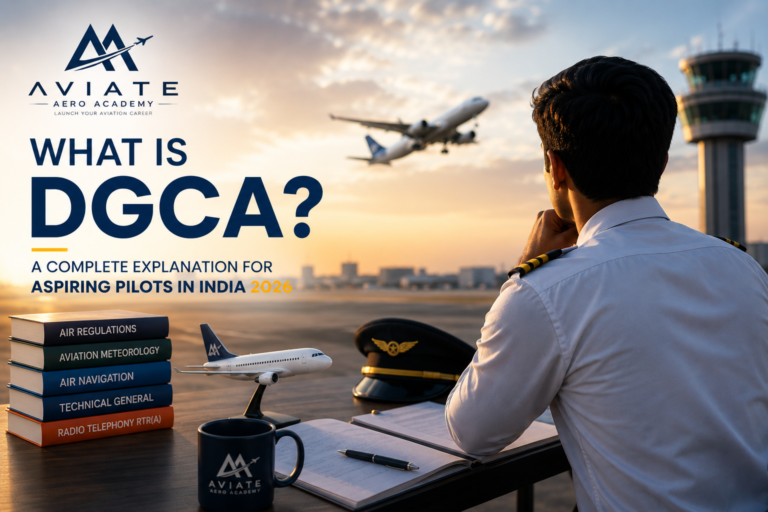
If you are researching a pilot career in India, the acronym DGCA appears in every article, every licensing document, every flying school description, and every official form. Despite this constant presence, most aspiring pilots begin their training journey without a complete, systematic understanding of what the DGCA is, what it controls, and how it directly shapes every stage of their career from first application to airline captaincy. This guide — written by Aviate Aero Academy’s ground coaching team in Hyderabad — provides that understanding clearly and completely for 2026.
What DGCA Stands For and What It Is
DGCA stands for the Directorate General of Civil Aviation. It is India’s national civil aviation regulatory authority, established under the Aeronautics Act and operating under the Ministry of Civil Aviation, Government of India. Headquartered in New Delhi with regional offices across the country, the DGCA performs the same regulatory function that the FAA performs in the United States, EASA in Europe, CASA in Australia, and CAAP in the Philippines — each country’s aviation regulator controls pilot licensing, school approvals, medical standards, safety oversight, and accident investigation within their jurisdiction.
What the DGCA Controls — The Full Regulatory Scope
- All pilot licensing in India: Student Pilot License, Private Pilot License, Commercial Pilot License, and Airline Transport Pilot License
- All DGCA written examination papers for pilot licensing — five mandatory subjects for CPL
- Approval and ongoing regulatory monitoring of all Flying Training Organisations — only DGCA-approved schools can train pilots toward Indian licenses
- Medical standards for all aviation personnel — designating Aviation Medical Examiners and setting Class 1 and Class 2 medical criteria
- Regulation of all Indian airlines, aircraft maintenance organisations, and airport operations
- The eCAAT portal — the digital hub for all pilot registration, examination booking, logbook submission, and licensing
- Aviation accident and serious incident investigation, airworthiness directives, and safety enforcement
The Five DGCA Written Examination Subjects
Every CPL candidate in India must clear all five DGCA written papers before their Commercial Pilot License can be issued. These examinations are conducted through the eCAAT portal at designated examination centres:
- Air Regulations (AR): Indian aviation law, ICAO standards, Air Navigation Orders, pilot rights and responsibilities
- Aviation Meteorology (MET): Weather theory for aviation, METAR and TAF decoding, icing, thunderstorm identification, wind shear, and aviation forecasting
- Air Navigation (NAV): Charts, flight planning calculations, VOR, NDB, ILS, GPS navigation, dead reckoning, and track-distance-time problems
- Technical General (TG): Aircraft systems in detail — engines, hydraulics, electrical, pressurisation, fuel, instruments, and avionics
- Radio Telephony RTR(A): ICAO phraseology, ATC communication procedures, emergency communications — earns the RT Licence required before solo flying
What Aviate Aero Academy’s faculty consistently observes: Navigation and Technical General have the lowest first-attempt pass rates among self-studying students in India. These subjects require conceptual understanding and calculation practice rather than memorisation. Structured coaching with mock tests delivers significantly better first-attempt outcomes — and saves students from costly re-examination delays. |
How DGCA Affects Your Career — Stage by Stage
Before Training Begins
Register on the DGCA eCAAT portal at ecarb.dgca.gov.in. Apply for your Student Pilot License with a valid Class 2 Medical Certificate and correctly formatted education documents. This process requires two to four weeks. Documentation errors cause significant and avoidable delays. Aviate Aero Academy provides eCAAT registration support for every student.
During Flying Training
Your flying school must hold a valid DGCA approval as a Flying Training Organisation. All flying hours are recorded in DGCA-format logbooks subject to audit. DGCA examination sittings are scheduled through the eCAAT portal, and CPL Skill Tests are conducted by DGCA-designated examiners.
CPL Issuance
After clearing all five written subjects and passing the CPL Skill Test, the DGCA issues your Commercial Pilot License. It is a lifetime license subject to periodic medical revalidation and proficiency checks.
ATPL Requirements
The Airline Transport Pilot License is issued by DGCA after 1,500 total flying hours, completion of ATPL theoretical examinations, and current medical revalidation. ATPL is required to serve as Pilot-in-Command on commercial transport aircraft.
Understand the full license progression from SPL to ATPL on the Aviate Aero Academy CPL to ATPL page.
DGCA and International License Conversion
Students who complete CPL training at internationally accredited schools — CAAP in Philippines, FAA in USA, Transport Canada, or CASA in Australia — hold a foreign CPL on return to India. Converting this to a DGCA CPL involves clearing remaining DGCA written subjects, sitting a DGCA skill test for conversion, and revalidating the Class 1 Medical with a DGCA-authorised examiner in India.
Students who complete DGCA ground classes at Aviate Aero Academy before departing for international training return to India exam-ready. This typically reduces the conversion timeline from a potential six to twelve months down to two to four months — a significant practical advantage that directly affects when the First Officer salary begins.
The DGCA eCAAT Portal — Key Practical Details
- Access at: ecarb.dgca.gov.in
- Functions: Student profile creation, document upload, SPL application, DGCA exam registration, logbook submission, CPL and ATPL licensing applications
- Most common errors: Incorrect document format, expired medical certificates, and name spelling mismatches across documents. All are avoidable with structured preparation.
At Aviate Aero Academy, we guide every new student through their complete eCAAT registration and documentation preparation as part of the initial counselling support — ensuring nothing is incorrectly formatted before any official submission.
Why DGCA Regulatory Currency Matters in Your Coaching Choice
DGCA updates its examination syllabus, question patterns, and regulatory circulars periodically. Coaching programmes that are not current with these updates teach content that may not reflect today’s examination papers — a practical problem that only surfaces when students see their results.
At Aviate Aero Academy, every element of our ground coaching is aligned with the current DGCA examination syllabus and regulatory framework. When DGCA issues updated circulars or modifies examination patterns, our curriculum updates accordingly. Students from across Hyderabad and South India choose us because we teach DGCA aviation the way it actually operates in 2026 — not based on material from years ago. This regulatory accuracy is one of the core reasons our students achieve strong first-attempt pass rates.
Seven Preparation Steps Before Your Medical
- Stop all caffeine consumption 48 hours before the examination — affects heart rate and blood pressure readings
- No alcohol for at least 72 hours — impacts liver function tests
- Minimum eight hours of quality sleep the night before — fatigue directly affects vision test performance
- Avoid heavy physical exercise for 24 hours — keeps resting ECG measurements accurate
- Fast for eight hours before blood tests — water is permitted
- Reduce prolonged screen time 24 hours before — protects vision test accuracy
- Bring all previous medical records, current prescriptions, and specialist reports — withholding information from the AME is both counterproductive and creates a documentation record issue
Medical Concerns Are Best Resolved Before Training Begins
One of the most valuable conversations a student can have before beginning any pilot training investment is an honest discussion about their medical fitness. At Aviate Aero Academy, the questions we address most frequently include borderline colour vision cases, prescription glasses near the refractive limit, LASIK timing considerations, blood pressure management, past injuries or surgical history, and family history of cardiac conditions.
We do not provide medical advice — only qualified Aviation Medical Examiners can do that. What we provide is informed career strategy advice based on over ten years of experience navigating the DGCA medical pathway with real students. If a health concern exists, we help students understand how it affects their CPL options, what specialist assessment they may need, and whether to proceed, pause, or approach the training differently. This guidance has protected dozens of families from significant investments made without medical clarity — and has reassured many students who incorrectly assumed a health concern would disqualify them.