DGCA to Airline Cockpit: What Actually Happens Between the Two?
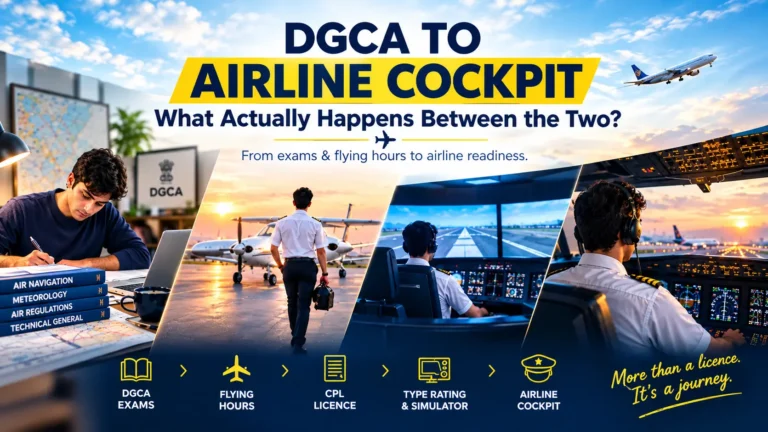
By Shravya, Aviate Aero Academy
Many aviation aspirants believe the journey is simple: clear DGCA exams, complete flying hours, get a Commercial Pilot Licence, and enter an airline cockpit.
That is the dream version.
The real version is more layered, more demanding, and far more important to understand before a student or parent invests serious time and money into pilot training.
A DGCA Commercial Pilot Licence is a major milestone. It proves that a student has met the regulatory requirements to become a commercial pilot. In India, CPL eligibility includes requirements such as 10+2 with Physics and Mathematics, medical fitness, and not less than 200 hours of flight time before licence issue.
But a CPL is not the same as an airline job.
This is where many students get confused. They think the licence is the finish line. In reality, it is closer to the gateway. It allows a student to move forward professionally, but the journey from DGCA licensing to an airline cockpit still requires preparation, selection, aircraft-specific training, discipline, and maturity.
The first stage is building the foundation. Before a student even reaches CPL, they must understand DGCA ground subjects properly: Air Navigation, Meteorology, Air Regulations, Technical General, and related aviation knowledge. These are not just exams to clear. They build the thinking framework of a pilot.
A pilot who does not understand weather, navigation, airspace rules, aircraft systems, and procedures will struggle later. Flying is not only about controlling the aircraft. It is about making correct decisions in changing conditions.
Then comes medical fitness. This is one of the most serious and sometimes overlooked parts of the journey. Aviation is a safety-sensitive profession, and medical requirements are not a formality. Students should never delay medical clarity until after spending lakhs on training. A dream must be checked against eligibility early, not after the investment has already begun.
Once ground preparation and medical requirements are understood, the student enters flying training. This is where theory meets the sky. The required 200 hours help build aircraft handling, radio communication, confidence, navigation practice, cross-country exposure, and instructor-led correction.
But again, completing hours is not enough.
The quality of those hours matters. Did the student understand mistakes? Did they build judgement? Did they fly in varied conditions? Did they become more disciplined after every sortie? Or did they simply collect logbook entries?
A licence built on weak learning creates problems later.
After CPL, the next stage is airline readiness. This is where the gap becomes visible. Airlines do not recruit candidates only because they hold a CPL. Their selection process can include application screening, aptitude assessments, technical evaluation, psychometric tests, simulator assessments, medical verification, and interviews, depending on the airline’s process.
This means students need more than a licence. They need communication skills, technical confidence, mental sharpness, and the ability to perform under pressure.
A candidate may know the theory but fail to explain it clearly. Another may have flying hours but struggle in simulator assessment. Some may have good knowledge but poor confidence in interviews. Some may not understand airline culture, crew coordination, or standard operating discipline.
The cockpit is not given to someone only because they completed the minimum.
It is earned by proving readiness.
For most airline careers, type rating also becomes important. Type rating is specialised training that qualifies a pilot to operate a specific aircraft type, such as an Airbus A320 or Boeing 737. Airlines often require pilots to complete the appropriate type rating before operating that aircraft commercially.
This is a major shift for students. CPL training teaches them to become commercial pilots. Type rating introduces them to airline aircraft systems, cockpit procedures, simulator-based operations, crew coordination, and aircraft-specific discipline.
This is where the student starts moving from “I know how to fly” to “I am learning how to operate as part of an airline cockpit.”
That difference is huge.
A modern airline cockpit is a professional environment built on procedure, teamwork, communication, automation management, safety culture, and decision-making. A pilot must know when to speak, when to listen, when to challenge, when to follow, and when to make a firm call.
That maturity does not appear automatically after 200 hours. It must be trained.
At Aviate Aero Academy, we often meet students and parents who are passionate but unclear about the full journey. As a Hyderabad-based aviation training and guidance academy, Aviate Aero Academy supports aspiring pilots with DGCA ground classes, CPL guidance, flying training assistance, type rating guidance, and global flying school guidance. Our focus is to help students move from confusion to clarity with a proper pilot career roadmap, so they do not treat aviation as a random sequence of decisions.
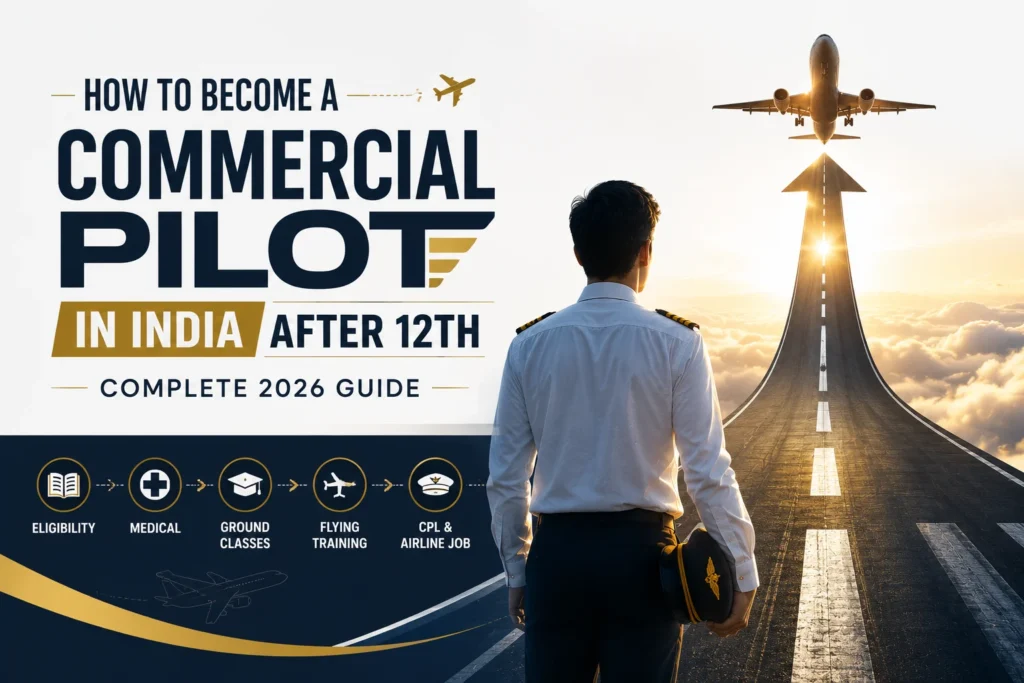
The real journey from DGCA to airline cockpit has several stages: eligibility, medicals, ground school, computer number, DGCA exams, flying training, CPL issue, airline preparation, selection process, type rating, simulator checks, induction, and line training.
Each stage matters.
Skipping clarity at one stage creates pressure at the next.
For parents, the message is simple: do not look only at the licence. Look at the readiness behind the licence. Ask whether the student understands the process, cost, timeline, medical requirements, training quality, and airline expectations.
For students, the message is even clearer: do not chase shortcuts. Aviation rewards discipline. The industry may need pilots, but it will always need safe, trained, mature, and professionally ready pilots first.
A DGCA licence opens the door.
But the airline cockpit belongs to those who build the foundation, respect the process, and prepare beyond the minimum.