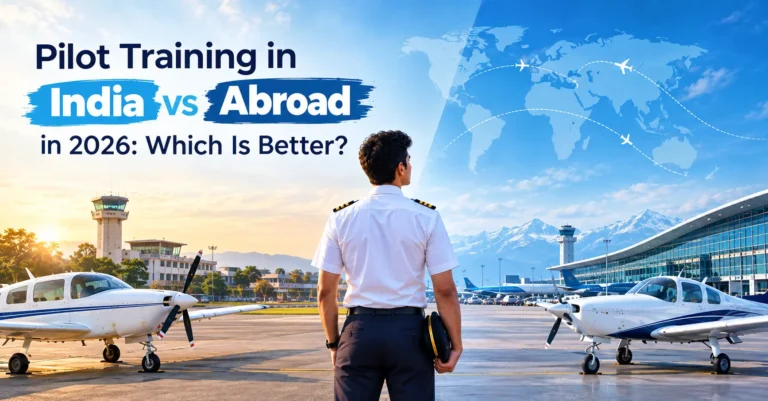
Pilot Training in India vs Abroad in 2026: Which Is Better?
By Shravya, Aviate Aero Academy
One of the most common questions we hear from students and parents is simple: should pilot training be done in India or abroad?
The honest answer is not simple.
There is no universal “better” option. There is only the right option for a specific student, budget, timeline, training goal, and airline career plan. In 2026, this question has become even more important because Indian aviation is growing, flying training capacity is improving, and students have more international options than ever before. But more options also create more confusion.
Pilot training is too expensive and too serious to be decided through Instagram reels, random YouTube opinions, or one senior’s experience from five years ago.
In India, the biggest advantage is regulatory alignment. If your goal is to fly for Indian airlines, training under the DGCA ecosystem keeps the pathway more direct. Students prepare for DGCA subjects, understand Indian aviation rules, build familiarity with local documentation, and train inside the regulatory structure they will eventually work under.
DGCA has also started pushing more transparency in flying training. The Ministry of Civil Aviation released the second phase of DGCA-approved Flying Training Organisation rankings in April 2026, describing it as part of a transparent, performance-driven, and quality-oriented framework for pilot training in India. The same release also said India expects around 50 more airports and Indian carriers inducting about 500 more aircraft in the next five years.
That matters.
For students and parents, Indian flying schools are no longer just local options to be judged blindly. There is now more conversation around performance, safety, infrastructure, aircraft availability, and training quality. This does not mean every Indian FTO is perfect. It simply means students now have better reasons to ask sharper questions.
The challenge in India is consistency. Some students may face delays because of weather, aircraft availability, maintenance downtime, instructor availability, or airspace congestion. Training quality can vary from one FTO to another. Cost may look lower initially, but delays can increase living expenses and extend timelines.
So India is not automatically cheaper or faster. It depends on the flying school and the student’s preparation.
Training abroad has its own advantages. Countries such as the USA, Canada, South Africa, Australia, New Zealand, and the Philippines are popular because some schools offer strong flying weather, structured training systems, high aircraft utilisation, and international exposure. For students who are disciplined and well-guided, training abroad can help them complete flying hours efficiently.
But this is where many families make a dangerous assumption: abroad does not automatically mean better.
A foreign flying school may have good aircraft and weather, but students must still check safety record, instructor quality, aircraft availability, approval status, cost transparency, accommodation, visa rules, medical requirements, refund policies, and the full conversion pathway back to India.
DGCA has reportedly cautioned students planning to train abroad that it does not monitor or regulate foreign flying schools and that its role is limited to licence conversion after training. That is a serious point. If a student chooses a poor overseas school, they cannot assume Indian regulators will protect them during training.
The biggest issue with training abroad is conversion. A foreign CPL is not automatically an Indian DGCA CPL. Students returning to India must complete the required DGCA conversion process, documentation, exams, medicals, skill checks, and regulatory requirements. DGCA’s Pariksha documents include foreign CPL/ATPL conversion procedures, and students must treat this as a major part of planning, not an afterthought.
This is where poor planning becomes expensive.
Some students complete flying abroad and return to India only to realise that paperwork is incomplete, hours do not match conversion expectations, documents are missing, or additional checks are required. This creates delays, frustration, and extra cost.
So which is better?
India is usually better for students who want a more direct DGCA-aligned pathway, prefer being closer to family, want easier communication with local mentors, and are comfortable with possible training delays if the school is reliable.
Abroad may be better for students who want faster flying-hour completion, are mature enough to live independently, can handle documentation carefully, and have proper guidance on DGCA conversion before they leave India.
But the real deciding factor is not country. It is readiness.
A serious aspirant must first ask: Have I cleared my medicals? Do I understand DGCA subjects? Is my budget realistic? Do I know the total timeline? Have I compared schools properly? Do I understand what happens after CPL? Am I prepared for type rating and airline selection later?
If these questions are unclear, changing the country will not solve the problem.
At Aviate Aero Academy, we see students and parents struggle with exactly this decision. As a Hyderabad-based aviation training and guidance academy, Aviate Aero Academy supports aspiring pilots with DGCA ground classes, CPL guidance, flying training assistance, type rating guidance, and global flying school guidance. Our focus is to help students move from confusion to clarity, compare India and abroad realistically, and build a proper pilot career roadmap before making a major financial decision.
The truth is simple: India vs abroad is the wrong first question.
The better question is: which training route will make this student properly prepared, financially protected, regulatorily compliant, and airline-ready?
In 2026, both India and abroad can be good options. Both can also become costly mistakes if chosen blindly.
A good pilot is not created by a location. A good pilot is created by quality training, strong ground knowledge, disciplined flying, honest guidance, and the maturity to take aviation seriously.
Choose India if it gives you structure and clarity.
Choose abroad if it gives you quality and conversion confidence.
But do not choose either because someone made it sound easy.
In aviation, easy decisions are often expensive. The right decision is the one made after proper research, realistic planning, and professional guidance.