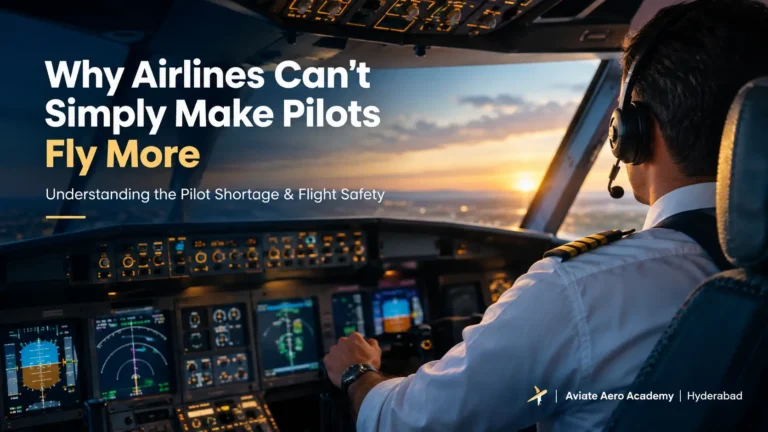
Why Airlines Can’t Simply Make Pilots Fly More During a Pilot Shortage
By Shravya, Aviate Aero Academy
Whenever the aviation industry talks about a pilot shortage, one question comes up very quickly: if airlines need more pilots, why can’t existing pilots simply fly more?
On the surface, it sounds practical.
There are aircraft to operate. Passengers need flights. Airlines need capacity. If there are not enough pilots, why not increase flying hours for the pilots already available?
But aviation does not work like a normal shift-based business.
A pilot is not just completing work hours. A pilot is carrying safety responsibility in a high-consequence environment. Fatigue, alertness, decision-making, reaction time, communication, and judgement all matter. When a pilot is tired, the risk is not only personal discomfort. It becomes an operational safety risk.
That is why airlines cannot solve a pilot shortage by simply stretching existing pilots further.
Aviation has strict rules for a reason. Regulators such as DGCA define limits around flight time, flight duty periods, rest periods, night operations, and cumulative duty. These rules exist because fatigue can reduce mental and physical performance, impair alertness, and affect a crew member’s ability to safely operate an aircraft. (Directorate General of Civil Aviation)
This is where many outsiders misunderstand pilot work.
A pilot’s duty does not begin when the aircraft takes off. It begins much earlier. There are briefings, weather checks, aircraft documents, operational planning, crew coordination, pre-flight procedures, passenger boarding, air traffic control communication, actual flying, post-flight procedures, delays, turnarounds, and sometimes unexpected disruptions.
So, when people say “just fly more,” they are usually looking only at the aircraft’s time in the air. They are not seeing the full duty load around that flight.
In aviation, duty fatigue is often more complex than simple tiredness. It can come from early morning reporting, late-night arrivals, irregular rosters, multiple sectors in one day, disrupted sleep, time pressure, weather changes, operational delays, and repeated high-alert decision-making. ICAO recognises fatigue as a state that can reduce mental or physical performance because of sleep loss, extended wakefulness, circadian rhythm, or workload. (ICAO)
This is why flight duty limitations are not unnecessary restrictions. They are safety barriers.
During a pilot shortage, airlines naturally face pressure. They need to operate schedules, protect revenue, maintain reliability, and avoid cancellations. But if the solution is to push existing pilots beyond safe limits, the industry only creates a larger problem.
A tired pilot may still be experienced. A tired pilot may still be professional. A tired pilot may still want to perform well. But fatigue does not ask for permission before affecting performance.
It can slow reaction time.
It can weaken concentration.
It can affect memory.
It can reduce situational awareness.
It can make small errors more likely.
It can make judgement less sharp during critical phases of flight.
That is not a work-life balance problem. That is a safety problem.
India has already seen the fatigue conversation become more serious. DGCA announced revised Flight Duty Time Limitation rules in 2024, saying the changes were designed to address pilot fatigue, enhance overall flight safety, and balance the growth of the aviation sector. The revised framework also moved towards Fatigue Risk Management Systems, which are more data-driven approaches to monitoring and managing fatigue.
This matters because Indian aviation is expanding fast. More aircraft, more routes, more airports, and more passengers will create more demand for pilots. But demand cannot be allowed to weaken safety culture.
The answer to a pilot shortage is not to overuse existing pilots. The answer is to build a stronger pilot pipeline.
That means better training capacity, clearer career guidance, stronger DGCA preparation, more transparent flying school selection, improved simulator exposure, better mentoring, and serious long-term planning. Airlines, regulators, training organisations, students, and parents all have a role to play.
For students, this is a lesson they must understand early. Aviation is not a profession where shortcuts are respected. The industry may need pilots, but it will never need unsafe pilots. Completing training is important, but becoming professionally ready is more important.
A future pilot must learn to respect rules, not fight them. They must understand that rest is not weakness. Reporting fatigue is not lack of commitment. Following duty limits is not laziness. These are parts of a mature safety culture.
Parents also need to understand this reality. Many families look at pilot careers only through the lens of salary, uniform, travel, and social status. But aviation is a responsibility-driven profession. The career demands discipline, irregular schedules, constant training, medical fitness, emotional maturity, and respect for safety systems.
At Aviate Aero Academy, we believe students should enter aviation with clarity, not fantasy. As a Hyderabad-based aviation training and guidance academy, Aviate Aero Academy supports aspiring pilots with DGCA ground classes, CPL guidance, flying training assistance, type rating guidance, and global flying school guidance. Our focus is to help students and parents understand the complete pilot career roadmap, including the discipline and safety mindset required beyond exams and flying hours.
The pilot shortage conversation should inspire aspirants, but it should not create a casual mindset.
Yes, the industry needs pilots.
But it needs pilots who are trained properly, rested adequately, mentally alert, technically strong, and professionally responsible.
An aircraft can be scheduled tightly. A route can be planned aggressively. A fleet can be expanded quickly. But a pilot cannot be treated like a machine that can be pushed endlessly.
The cockpit requires a human being at their best.
That is why airlines cannot simply make pilots fly more during a shortage. Because aviation safety is not built on maximum utilisation alone. It is built on discipline, limits, preparation, and judgement.
The future of aviation will not belong to airlines that only fly more.
It will belong to an industry that trains better, plans smarter, and respects the human limits of the people trusted to fly.