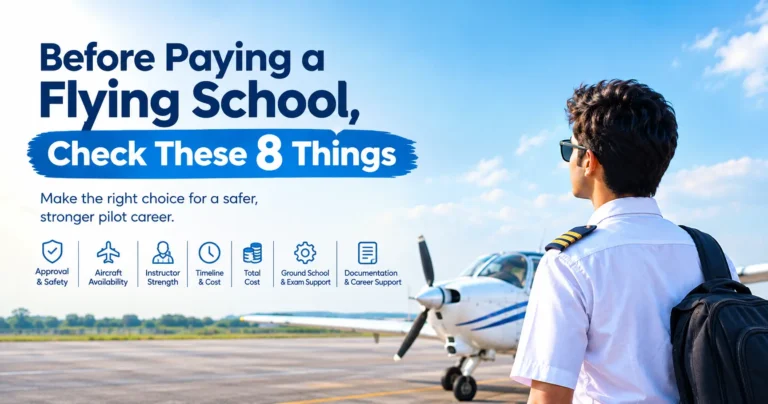
Before Paying a Flying School, Check These 8 Things
By Shravya, Aviate Aero Academy
Pilot training is one of the most emotional decisions a family can make.
For the student, it is a dream. For the parents, it is an investment. For both, it is a moment filled with hope, questions, fear, and pressure. And that is exactly why the decision should never be rushed.
Before paying any flying school, students must understand one hard truth: a flying school is not just a place where you complete hours. It is where your aviation foundation is built.
In India, a Commercial Pilot Licence requires serious preparation, including DGCA exams, medical fitness, and the required flying experience. Completing 200 flying hours is a key milestone in the CPL journey, but the quality of those hours matters as much as the number itself. DGCA has also asked flying schools to publish important information such as aircraft strength, instructors, examiners, simulator availability, ground school availability, and the minimum and maximum time taken to complete 200 hours. That alone tells us that students are expected to compare schools carefully, not blindly. (The Times of India)
So before you pay a flying school, check these eight things.
First, check whether the flying school is DGCA-approved.
This is non-negotiable. Do not depend only on brochures, agents, or social media posts. Verify whether the Flying Training Organisation is approved and currently active. A good-looking website does not make a school reliable. In aviation, approval, compliance, and safety matter more than presentation.
DGCA has also introduced an FTO ranking framework to improve training standards, safety, accountability, and transparency across approved flying training institutions. The Ministry of Civil Aviation has described this ranking system as a reform aimed at strengthening India’s pilot training ecosystem. (Press Information Bureau)
Second, check aircraft availability.
A flying school may quote attractive timelines, but the real question is: how many serviceable aircraft are available for students?
If the school has too many students and too few aircraft, training delays become almost guaranteed. Aircraft may also be unavailable due to maintenance, weather, inspections, or operational issues. Ask how many aircraft are actually flying regularly, not just how many are listed on paper.
Third, check instructor strength and student ratio.
A student does not become a better pilot only by sitting in an aircraft. They become better through correction, briefing, feedback, and repeated learning.
If instructors are overloaded, students may not receive enough individual attention. Ask how many instructors are available, how often students fly, how progress is reviewed, and how weak areas are corrected. Good instruction saves time. Poor instruction creates repeated mistakes.
Fourth, check the realistic timeline to complete 200 hours.
Many schools market ideal timelines. Students and parents must ask for realistic timelines.
How long do students actually take to complete 200 hours? What is the minimum and maximum completion time? Are there weather-related delays? Are there aircraft downtime issues? Are students waiting for slots?
DGCA’s direction asking flying schools to display completion timelines is important because delays directly affect cost, confidence, and career planning. (The Times of India)
Fifth, check total cost, not only course fee.
This is where many families make a mistake.
A flying school may quote a base fee, but the real cost can include accommodation, food, transport, uniforms, exams, medicals, documentation, additional flying, retests, simulator sessions, licence processing, and delays.
Before paying, ask for a written cost breakdown. If a school avoids clear answers, take that as a warning sign. In aviation, vague pricing is not a small issue. It can become a financial trap.
Sixth, check safety culture and maintenance discipline.
Students often forget this because they are too focused on cost and speed.
But aviation is a safety-first profession. Ask about aircraft maintenance, safety audits, operational discipline, incident history, and how the school handles weather or technical delays. A school that cancels flying for safety reasons may frustrate students in the short term, but that culture protects them in the long term.
Never choose a school that treats safety like an inconvenience.
Seventh, check ground school and exam support.
Flying alone will not make you a complete pilot. DGCA subjects are the foundation of aviation thinking.
Navigation, meteorology, air regulations, technical knowledge, and radio communication are not just exams to clear. They shape how a pilot understands risk, weather, procedures, and decision-making. Before joining a flying school, ask whether structured ground support is available or whether students are expected to manage theory on their own.
A weak theory foundation will show up later during flying, interviews, simulator assessments, and type rating.
Eighth, check documentation and career roadmap support.
Pilot training involves paperwork, medicals, exams, flying logs, licence application, verification, and sometimes conversion procedures if training is done abroad. Poor documentation can delay licensing even after flying is completed.
Also ask what happens after CPL. Does the school guide students on type rating, airline preparation, simulator readiness, or interview expectations? A CPL is a major milestone, but it is not the final destination. The real goal is airline readiness.
At Aviate Aero Academy, we meet many students and parents who are passionate but confused about where to begin. As a Hyderabad-based aviation training and guidance academy, Aviate Aero Academy supports aspiring pilots with DGCA ground classes, CPL guidance, flying training assistance, type rating guidance, and global flying school guidance. Our focus is to help families move from confusion to clarity, so they understand the complete pilot career roadmap before making expensive decisions.
The biggest mistake is not choosing India or abroad. It is not even choosing a school that is slightly more expensive.
The biggest mistake is paying before asking the right questions.
Aviation rewards preparation. It does not reward shortcuts.
Before paying a flying school, slow down. Verify approval. Compare aircraft availability. Understand timelines. Check instructor quality. Calculate total cost. Study safety culture. Confirm ground support. Clarify documentation.
Because the cockpit will not ask how quickly you enrolled.
It will ask whether your foundation was strong enough to carry the responsibility of flight.