How Aircraft Delivery Delays Can Affect Pilot Hiring
By Shravya, Aviate Aero Academy
For every aviation aspirant, aircraft delivery news feels personal.
When airlines announce new aircraft, students see opportunity. Parents see career stability. Training academies see a growing pipeline. The industry sees expansion. A new aircraft is not just metal, engines, seats, and systems. It represents new routes, more capacity, more crew requirements, and potentially more pilot hiring.
But there is another side of aviation growth that students rarely understand clearly: aircraft orders and aircraft deliveries are not the same thing.
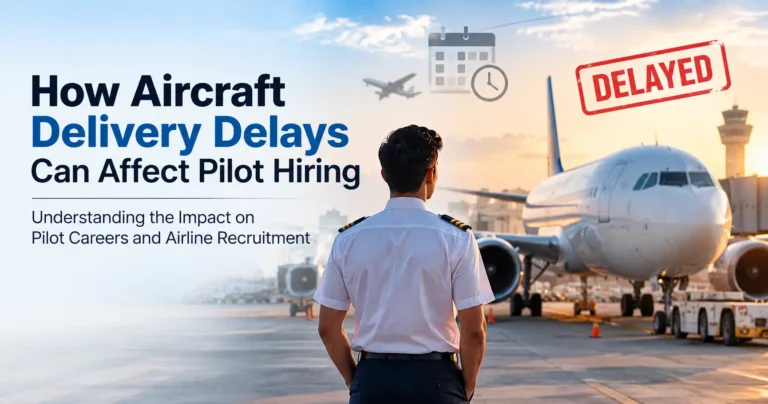
An airline can order hundreds of aircraft today, but those aircraft may arrive over many years. Some may arrive late. Some may be deferred. Some may be affected by supply chain issues, engine availability, certification timelines, financing decisions, operational disruptions, or changes in airline strategy.
And when aircraft deliveries shift, pilot hiring can also shift.
This does not mean pilot demand disappears. It means hiring timelines can become uneven.
That is the first serious lesson young pilots must understand.
Aircraft delivery delays affect airline planning because airlines hire pilots based on actual operational need, not just future ambition. A carrier may have a large order book, but if aircraft are delayed, it may not need all the planned pilots immediately. Training batches may be postponed. Type rating plans may slow down. Recruitment may become more selective. Joining dates may move.
This is why students should never plan their aviation career only around headlines.
Globally, aviation supply chains have been under pressure. IATA has highlighted that aircraft deliveries were still well below pre-COVID peaks in 2024, while the global backlog had grown to around 17,000 jets. Engine issues have also grounded hundreds of aircraft, leaving airlines short of capacity. (IATA)
For airlines, this creates a difficult situation. Demand may be strong, passengers may want more flights, and airlines may want to grow, but aircraft availability controls how fast that growth can actually happen.
India is seeing similar complexity. Reuters reported in June 2026 that Air India was looking to defer delivery of hundreds of jets from Airbus and Boeing as it managed cost pressures and operational disruptions. The airline had placed a major in 2023 as part of its transformation plan. That is not a small detail for pilot aspirants.
When an airline slows aircraft induction, hiring does not always stop, but it can become more calibrated. Airlines may continue hiring for replacement needs, retirements, training pipelines, network requirements, and future readiness. But aggressive recruitment linked to rapid fleet growth can be adjusted.
This is where the difference between “industry demand” and “individual readiness” becomes important.
Aviation may need more pilots over the long term. Airbus notes that a doubling of the global in-service fleet will create demand for new pilots, technicians, and cabin crew across the aviation acosystem. But long-term demand does not mean every student will get an immediate airline job the moment they complete training.
Pilot hiring moves with aircraft deliveries, airline profitability, route expansion, fuel prices, geopolitical disruptions, airport slots, simulator capacity, regulatory approvals, and training throughput.
That is the reality.
For students, this should not create fear. It should create maturity.
If aircraft deliveries are delayed, the wrong response is panic. The right response is preparation.
A serious student should use that time to strengthen their knowledge through structured DGCA ground classes, improve technical understanding, and develop communication skills, prepare for simulator assessments, understand airline selection processes, and become a stronger candidate. A delay in the market can become an advantage for the student who uses it well.
But many aspirants do the opposite.
They wait passively. They keep asking when airlines will hire. They follow every rumour. They jump from one headline to another. They complete training but do not build confidence for interviews, technical rounds, aptitude tests, or simulator checks.
That is weak preparation.
The industry does not reward students who only wait for opportunity. It rewards students who are ready when opportunity returns.
Aircraft delivery delays can also affect type rating decisions.Understanding type rating after CPL is important before making aircraft-specific training investments If an airline delays inducting a particular aircraft type, hiring for that fleet may slow. If another fleet type is expanding faster, demand may shift. This is why students must avoid blindly choosing expensive next steps without guidance. A type rating decision should be made after understanding airline trends, personal readiness, market timing, and financial risk.
Parents must also understand this clearly. Pilot training is a serious investment.Understanding the cost of pilot training in India can help families plan more realistically for the complete journey. It is wrong to assume that aircraft orders automatically guarantee immediate hiring. The smarter approach is to prepare the student properly, plan finances realistically, and understand that aviation careers move in cycles.
At Aviate Aero Academy, we often meet students who are inspired by big aircraft orders but confused about the actual path. As a Hyderabad-based aviation training and guidance academy, Aviate Aero Academy supports aspiring pilots with DGCA ground classes, CPL guidance, flying training assistance, type rating guidance, and global flying school guidance. Our focus is to help students and parents move from excitement to clarity, so they understand the complete pilot career roadmap instead of depending only on industry headlines.
The truth is simple: aircraft delays may slow hiring timelines, but they do not remove the need for well-trained pilots.
Airlines will still need safe, disciplined, technically strong, professionally mature pilots. But they will hire based on operational readiness, not student anxiety.
So, what should aspiring pilots do?
Start early. Check medical eligibility. Take DGCA subjects seriously. Choose flying schools carefully. Understand timelines and costs. Build communication and technical confidence. Do not rush into expensive decisions without clarity. Do not treat aircraft orders as a job guarantee. And most importantly, do not wait for the market to become perfect before becoming serious.
Aviation growth is real, but it is not always linear.
Aircraft may be delayed. Deliveries may shift. Hiring may move in cycles. But preparation should not stop.
Because when the aircraft finally arrive, airlines will not be looking for students who merely watched the news.
They will be looking for pilots who used the waiting period to become ready.
Planning your aviation career? Get personalised guidance on DGCA preparation, CPL training, flying school selection, and career pathways. Book your free pilot counselling session with Aviate Aero Academy.