
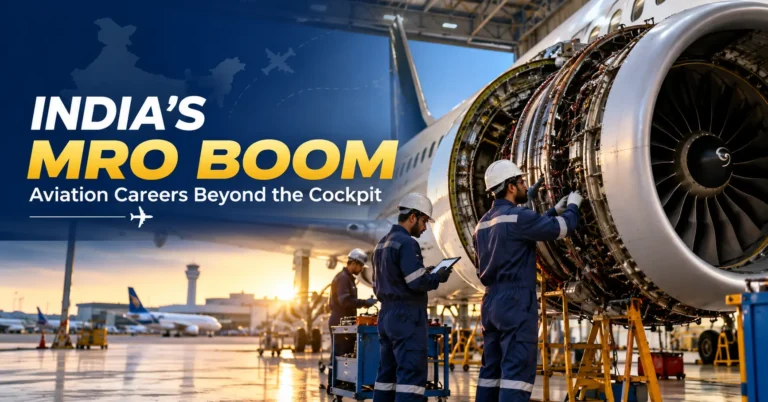
India’s MRO Boom: Aviation Careers Beyond the Cockpit
By Shravya, Aviate Aero Academy
When most students think about aviation careers, they imagine the cockpit first.
The uniform. The aircraft. The airport walk. The responsibility of flying passengers from one city to another. For many young aspirants, becoming a pilot is the dream that brings them into aviation.
But India’s aviation future is not being built only inside cockpits.
It is also being built inside hangars, maintenance bays, engine shops, component repair facilities, technical operations rooms, quality departments, training centres, and airport support systems. This is where one of India’s most important aviation opportunities is growing quietly: Maintenance, Repair, and Overhaul, better known as MRO.
MRO is the backbone that keeps aircraft safe, airworthy, and operational. Every aircraft needs scheduled maintenance, inspections, repairs, component checks, engine work, software updates, documentation, and technical compliance. Without MRO, aircraft do not fly. It is that simple.
India’s MRO opportunity is becoming much larger because the country’s aircraft fleet is expanding rapidly. Airbus has projected that India’s commercial aircraft fleet could triple to around 2,250 aircraft by 2035, while the MRO market for airframes, engines, and components could also triple to about US$9.5 billion by 2035. The same projection says India may require 34,000 technicians by 2035, up from around 11,000 today.
That number should make students pause.
Aviation is not only creating opportunities for pilots. It is creating demand for aircraft maintenance engineers, technicians, avionics specialists, quality inspectors, planning engineers, logistics teams, safety professionals, technical records teams, and operations support staff.
This matters because many students who love aviation think their only option is to become a pilot. That is not true.
The cockpit is one aviation path. It is an important one, but it is not the only one. As India grows into a larger aviation market, careers beyond the cockpit will become more visible, more technical, and more valuable.
The government has also recognised this shift. India implemented a uniform 5% IGST rate on aircraft parts in 2024 to support the domestic MRO industry, reduce operational cost challenges, and attract investment. The Ministry of Civil Aviation said the Indian MRO industry was projected to become a US$4 billion industry by 2030.
That policy direction is important because India has historically depended heavily on overseas maintenance facilities for some aircraft work. If more MRO work happens within India, the country can save cost, reduce aircraft downtime, create skilled jobs, and strengthen aviation self-reliance.
For students, this means aviation career planning needs to become broader.
A student who is interested in aircraft systems, engineering, troubleshooting, safety, engines, avionics, structures, or technical documentation should not ignore MRO careers. These are not “backup options.” They are core aviation roles. A pilot may operate the aircraft, but maintenance professionals ensure that aircraft is safe to operate in the first place.
That responsibility is serious.
Aircraft maintenance is not ordinary mechanical work. It is regulated, documented, audited, and safety-sensitive. A small error in maintenance can have serious consequences. This is why MRO careers need discipline, technical knowledge, precision, patience, and respect for procedures.
The future aviation workforce will need people who can work with modern aircraft systems, digital maintenance platforms, predictive analytics, engine health monitoring, composite materials, avionics, cybersecurity-linked aircraft systems, and global compliance standards. Aviation maintenance is becoming more advanced, not less.
India’s aviation hub ambition also depends heavily on MRO. At Wings India 2026, the government highlighted India’s emergence across aircraft MRO, pilot training, aerospace manufacturing, cargo logistics, and advanced air mobility. That shows the future aviation ecosystem will need multiple types of trained professionals, not just pilots.
This is where parents and students must change their mindset.
If a student wants aviation but may not be medically eligible to become a pilot, that does not mean the aviation dream is over. If a family cannot afford the full pilot training route, that does not mean the student has no place in aviation. If someone is stronger in engineering than flying, MRO may be a serious and respected path.
The aviation industry needs both people who fly aircraft and people who keep aircraft flying safely.
At Aviate Aero Academy, we meet many students who enter with one dream but need honest career clarity. As a Hyderabad-based aviation training and guidance academy, Aviate Aero Academy supports students with DGCA ground classes, CPL guidance, flying training assistance, type rating guidance, and global flying school guidance. But we also believe students must understand aviation as a complete ecosystem. The goal is not to sell one dream blindly. The goal is to help students and parents understand the right path based on eligibility, interest, budget, discipline, and long-term career direction.
India’s MRO boom should be seen as a wake-up call.
The future of aviation will not be limited to who sits in the cockpit. It will also depend on who maintains aircraft, who certifies systems, who manages technical records, who plans maintenance schedules, who ensures compliance, and who protects safety from the ground.
Young aviation aspirants should ask better questions now.
Do I understand all aviation career paths?
Am I suited for flying, engineering, operations, or technical roles?
Do I know the difference between pilot training, AME pathways, MRO careers, and airline operations?
Am I choosing aviation because I understand the industry, or only because I like the image of it?
These questions matter.
India’s aviation growth is real. More aircraft are coming. More airports are operating. Airlines are expanding. MRO investment is rising. Technical workforce demand is growing.
But aviation will reward only those who prepare properly.
The cockpit will always remain aspirational. But the hangar is where safety begins before the aircraft ever reaches the runway.
And in India’s next aviation chapter, careers beyond the cockpit may become just as important as the ones inside it.